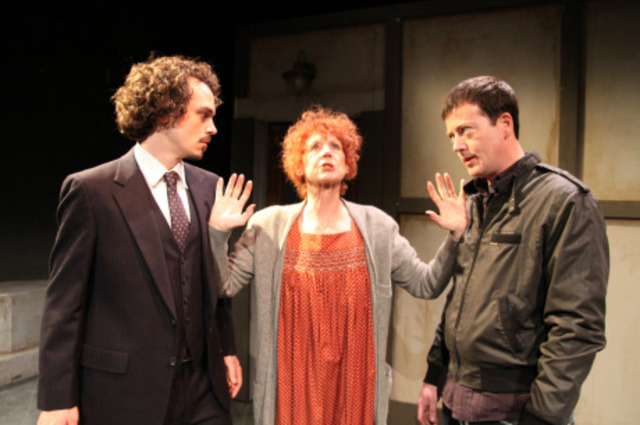
 Ian Blackwell Rogers, Rena Cherry Brown and Barry McEvoy in ‘Public Enemy’.Photo: Ian C. Armstrong
Early in Kenneth Branagh’s career, the young phenom — already well established as an actor on the British stage and on the brink of being declared the heir apparent to Laurence Olivier as the premier cinematic interpreter of Shakespeare — tried his hand at playwriting. One of the two works that emerged during that period is this fascinating angle on “The Troubles” in Northern Ireland, set during the height of conflicts between the two paramilitary groups fighting over Northern Irish identity, the UK-loyalist Ulster Freedom Fighters (UFF) and the nationalist Irish Republican Army (IRA). Branagh approaches the politics obliquely, using it as a backdrop that moves steadily to the fore of a smaller story about a young Belfast man obsessed with the legacy of James Cagney.
In Scena’s current production, Belfast native Barry McEvoy stars as Tommy Black, out of work and trying to make his way as a performer, winning talent contests and playing bars with his dead-on impersonation of Cagney, both from his song-and-dance work, and his thuggish gangster persona in films like Angels with Dirty Faces, White Heat, and especially the role of Tom Powers in The Public Enemy. He lives with his more practical (but equally unemployed) brother, and his drunk, tenuously employed mother.
Black’s raw charisma impresses audiences and inspires devotion in his best friend and young girlfriend, but as the play wears on, the line between Tommy Black and Tom Powers begins to disintegrate, and Tommy begins to emulate not only Cagney’s mannerisms, but his criminal character. His illicit activities draw the attention of the police, as well as the UFF and the IRA; Tommy has no gang of his own, but he’s stepping on the toes of the most powerful and violent players in Belfast.