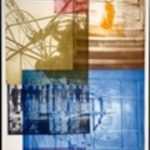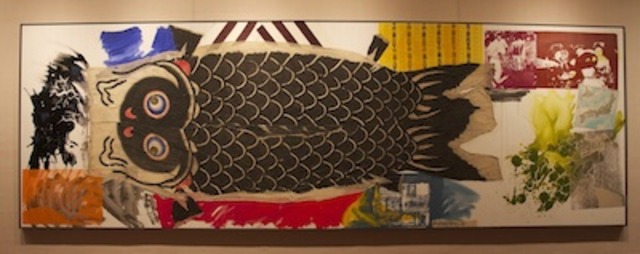
 Image of Rauschenberg’s “Wall-Eyed Carp/ROCI JAPAN” courtesy of the National Gallery of Art
With the World Cup picking up pace in South Africa and fans flooding into stadiums or lining up in front of screens, I thought we’d take a little taste of another world tour today, in the company of the artist Robert Rauschenberg (1925–2008).
Rauschenberg: what a rock star. He moved away from Abstract Expressionism when others were moving toward it and ultimately loosened the movement’s grip on American art. He invented the ‘combine painting’, a trail-blazing art form in which he mixed up an often out-there mesh of images and media: oil painting, screen-printed images, 3D things you’d buy at the market, a stuffed goat with a tire around its middle. It all went into his mad melting pot. Later, in the 1960s, he started down the 2D path, using collage and newspaper images to make prints that said important things about modern life. Rauschenberg said, “Painting relates to both art and life. A pair of socks is no less suitable to making a painting than wood, nails, turpentine, oil, and fabric.” See what I mean? The man’s a dude.
We’re picking him up on his Rauschenberg Overseas Culture Interchange tour (R.O.C.I., pronounced “Rocky”), which kicked off in Mexico City in 1985. R.O.C.I. was an ambitious nonprofit project conceived (and in large part funded) by the artist to create communication with global nations through the language of art. Our work today, Wall-Eyed Carp/ROCI JAPAN (1987), was part of that project.
Here’s the drill: R.O.C.I. goes to a country to work with local artists and artisans. They make art. He returns to a major museum in that country to exhibit that art (as well as what’s been produced in other R.O.C.I. nations) to the public. At each stop along the way, Rauschenberg left a gift of some art made there, as well as sending a piece from each outpost straight to the National Gallery of Art in Washington, for a cumulative exhibition that took place there in 1991.