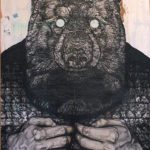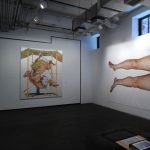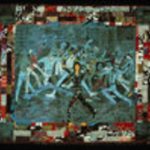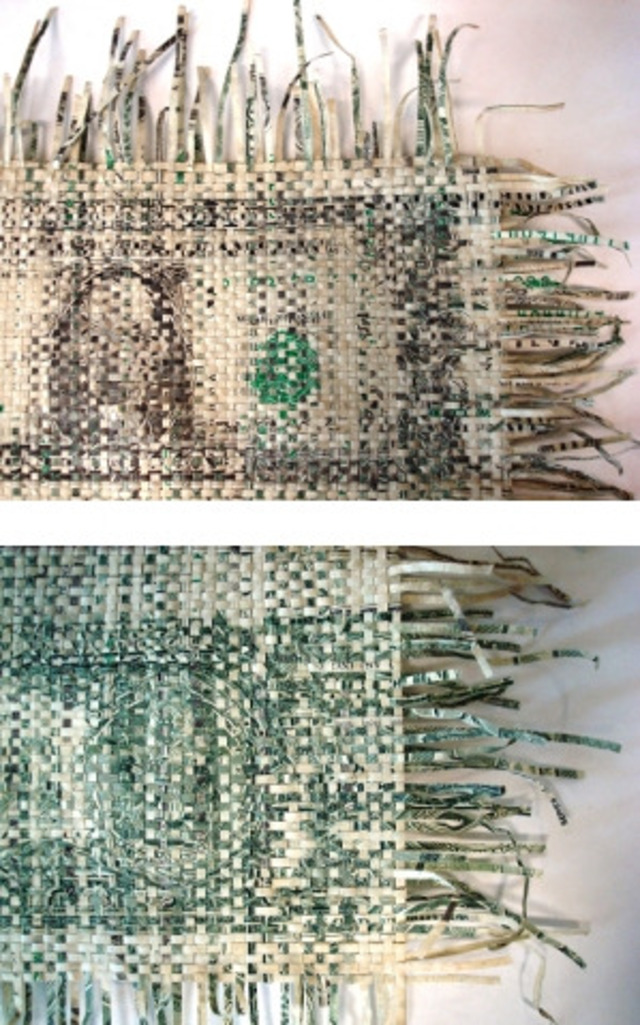
 Detail image of “Another day another dollar,” by Jason Hughes, courtesy the Arlington Arts Center
Written by DCist contributor Matt Smith
While not every curator is an artist, every artist is a curator, or at least every artist wishes she were one, if only briefly. Art Scouts,” at the Arlington Arts Center through August 21, engages six highly accomplished artists with local ties (Zoe Charlton, Mary Early, J.J. McCracken, Maggie Michael, Jefferson Pinder, and Kerry Skarbakka) and asks them to select works by other artists who they feel inform their own art-making process. The artists-as-curators represent six distinct disciplines and their selections are at times a neat reflection of the media in which they work, and at other times a more specific sample of styles similar to their own. The resulting show is an invigorating survey of 28 artists that makes excellent use of the extensive exhibition space at the AAC, including seven of the nine galleries across two stories.
Although she is considered one of the best painters in the D.C. area, Maggie Michael’s current work reflects a growing interest in 3D multimedia installations, as evidenced by her solo show at George Mason University earlier this year, “Tattoos of Ships.” As a result, it’s not surprising that her selections for “Art Scouts” largely omit the painting medium – with some exceptions – and mostly include works with sculptural elements that make use nontraditional materials. Dustin Carlson’s entrancing sound piece, Sirens, emits finely tuned high-pitched tones from electrical components inside three halved and gutted fire extinguishers. Hold your ear close to one of the fire extinguishers and you can feel the sound source, whatever it is, gently reverberating through the air and across your eardrum. Jason Hughes’ two pieces revolve around the redefinition and reconstruction, quite literally, of money. In Another day another dollar, Hughes has shredded a one dollar bill and then meticulously reconstructed it by weaving the paper shreds as if it were a miniature flat woven rug. The result is a textured object that emphasizes the manufactured nature of currency.