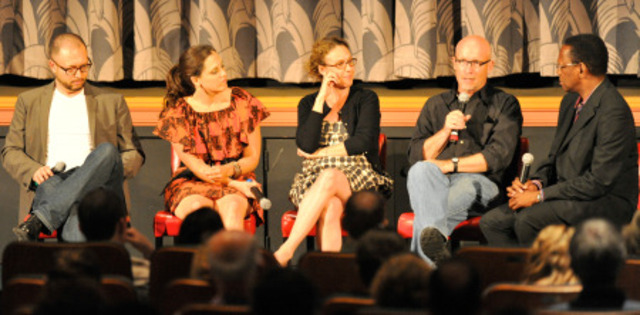
 Last night’s post-screening discussion with (from left) ‘Freakonomics’ Producer Chad Troutwine, filmmakers Heidi Ewing, Rachel Grady and Alex Gibney, with moderator and financial advisor Alvin Hall. Photo courtesy Silverdocs.
The 2010 Silverdocs festival got underway last night, with a slightly more sedate affair than the NBA star-studded red carpet function with the Wale-soundtracked afterparty that kicked things off in 2009. Last year’s party, though probably tame by NBA standards, was an approximation of pro sports glitz. This year, the opening film was Freakonomics, based on the best-selling pop-econonomics book of the same name. And so it was that the champagne reception that followed the screening was more in line with an academic affair for university economists. Given the Silverdocs demographic, and the blank stares that greeted last year’s Go-Go spinning DJ, this was probably the afterparty better suited to the occasion.
The film itself was an engaging, slick and entertaining documentary, serving exactly the purpose an opening night film should: appeal to a broad audience with easy likability, and get people fired up for the week of films that is to follow. Freakonomics might seem an odd choice for a filmed adaptation, given that its only through line is economist and co-author Steven Levitt’s commitment to the idea of economics as the expression of human psychological response to incentives. The examples that he and co-author and journalist Stephen Dubner use to illustrate are unrelated to one another, and illustrate disparate points. But producer Chad Troutwine looked on this as a potential strength, and enlisted five prominent documentarians to create an omnibus doc that would allow each of them to choose and film a different part of the book.
Of course, omnibus films are rarely 100% successful, and Freakonomics does fall victim to some of the usual problems inherent to mashing together short films by stylistically distinct directors into one feature. The producers attempt to mitigate the tonal shifts slightly by tasking one of their directors, King of Kong‘s Seth Gordon, with filming interlude segments to bridge the four longer short films by the other directors. Gordon’s pieces, which center around interviews with Levitt and Dubner, do give the film a consistent home base to return to (and are excellent, brief distillations of their thinking), though they don’t quite smooth over the rough edges that are bound to spring up when, say, the irreverent, sardonic style of Morgan Spurlock (Super-Size Me) runs up against the dark, near-operatic elegance of Alex Gibney (Taxi to the Dark Side).