
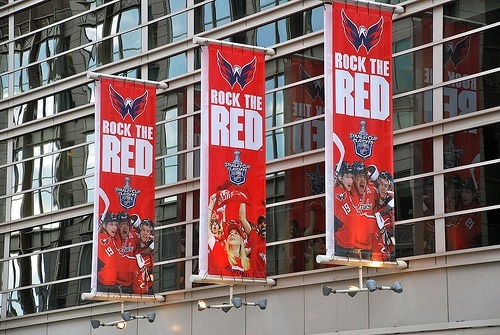
 Photo by afagen.
Who is Evgeny Kuznetsov? A lot of D.C. publications will ask this question in the next few weeks, but we won’t. Okay, sure, he’s a six foot tall, 172 pound kid who was born in a time when Courtney Love was a legitimate feminist icon and global superstar. But it’s not when he was born, what he eats for breakfast, what kind of music he listens to, what he believes in or how many goals he scored as captain of his team in the under-18 world championships (five, plus seven assists — in seven games) that made Kuznetsov the right choice for the Capitals in last night’s 2010 NHL Entry Draft. It’s where he was born. In Russia.
We reminded you last night that the Capitals built their current success by closely following the models of the most successful teams of the nineties and aughts, particularly the Detroit Red Wings. One subject the Red Wings mastered was geography. Today, the Red Wings have six Swedish players and only one Russian, but in their heyday of the early aughts, they were known and feared for their Russians.
The Wings didn’t just have Sergei Fedorov, the best Russian player of his day. They had an entire unit of five Russian players to compliment him on the ice. This made Fedorov much more effective than he proved later, playing in Anaheim or Columbus with mostly North American and Western European players. Fedorov’s play improved significantly when he was traded to the Capitals and tasked with mentoring Alexander Ovechkin and Alexander Semin.
Ovechkin, the best Russian player and the best hockey player of our time, continues learning English at a prodigious clip and wants to be able to play with anybody in the NHL. But his frequent linemate, Semin, has remained much more comfortable with his native language. Goaltender Simeon Varlamov still gives interviews in Russian, speaking through a translator. Perhaps a few more familiar faces could help ease everybody’s transition. The Capitals are certainly working on it.