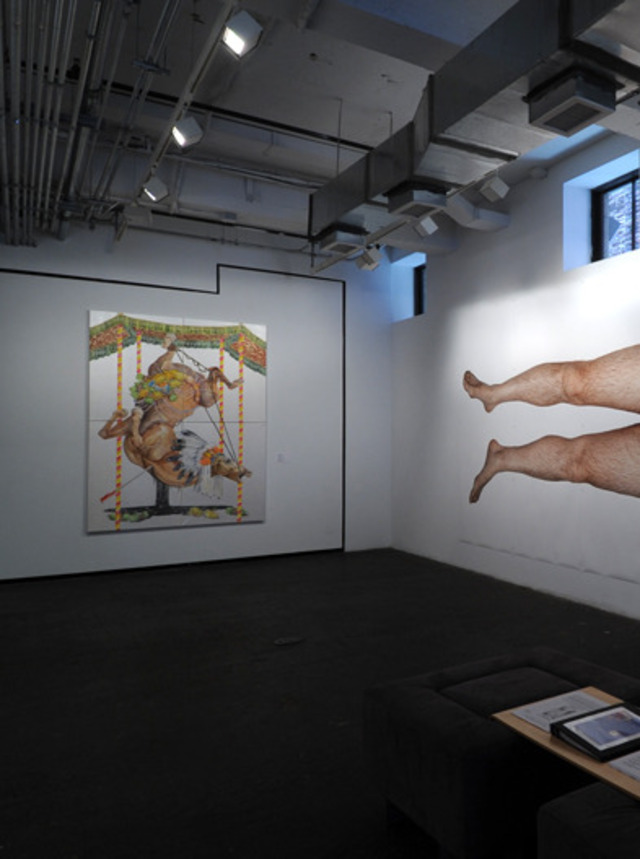
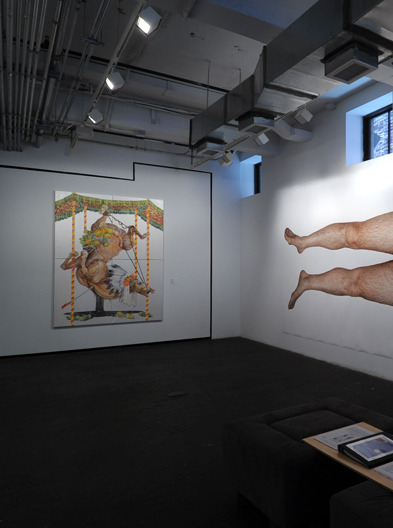
 (Pictured Left) Jenny Sidhu Mullins, “Mountain Dew Presents: The Dew-Love Dharma Tent,” 2010. (Pictured Right, in part) Jason Horowitz, “Annunciation (Jeffry),” 2010, courtesy Curator’s Office. Installation photograph by Brandon Webster, courtesy Flashpoint.
Written by DCist contributor Matt Smith
By Request, at the Gallery at Flashpoint through July 31, is artist and curator Jeffry Cudlin’s take on the field of cultural production, a theory examining how art is produced and how we as a society come to accept it as such. Cudlin explains that according to this theory, “if you want to know why art looks the way it does, the answer has to do with all these people in positions of authority jostling and coming to a shifting, uneasy consensus as to what art is and how it ought to function.” This ever-changing consensus informs museums’ and galleries’ decisions, and these decisions in turn shape the work of aspiring young artists in search of legitimacy.
So Cudlin, who DCist profiled in 2008, gathered seven power players in the D.C. art world (the director of the Phillips Collection, the Associate Curator of Prints and Drawings of the National Portrait Gallery, the founder of the Pink Line Project, and other notable figures) and had them respond to a survey that purports to get at their artistic preferences. His contention is that if this theory is true, then the seven artists enlisted for the show should be able to produce artwork that is compelling and relevant by simply following the implicit instructions contained within the completed surveys. Through this process, Cudlin explains, the show “aims for total transparency within the field of cultural production — collecting and evaluating the opinions of professionals in an attempt to thoroughly explain why D.C. gallery culture looks the way it does.”
Of course, Pierre Bourdieu’s ideas aren’t meant to be interpreted quite so literally, and the stipulation that all artwork produced for the show must be a depiction of Cudlin himself — the “Cudlin clause,” if you will — would seem to indicate that Cudlin is not exactly interested in the artist’s exploration of the surveys. Not surprisingly, the resulting artwork is not a real attempt at explaining D.C. gallery culture, with their only purpose, it would appear, is to remind us of Cudlin’s connections to notable artists.