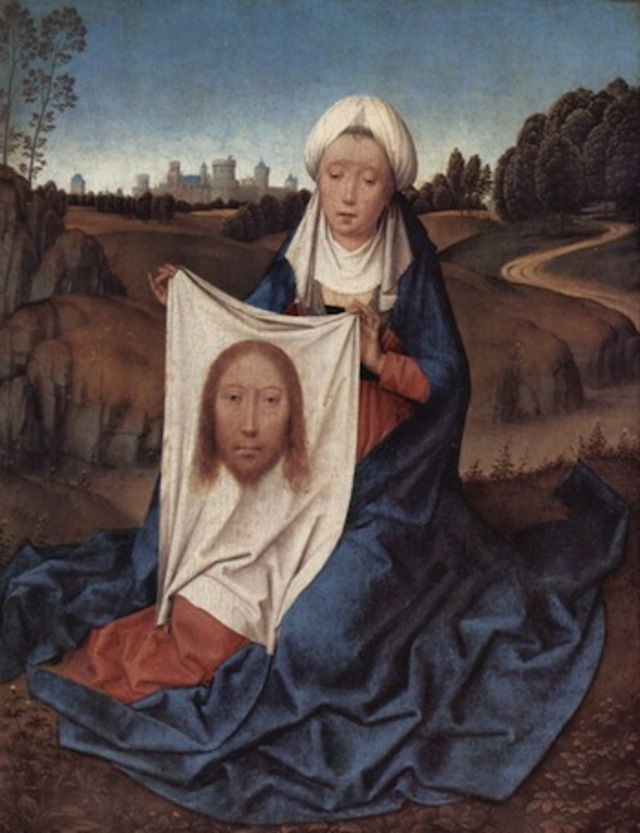
 Image of Memling’s “Saint Veronica” courtesy of the National Gallery of Art.
My most churning church experience was a feast for Saint Gennaro in Naples one year, where a cardinal from Rome rocked two vials of a 3rd century saint’s be-crusted blood before a congregation of avid believers. After 18 minutes, he said the blood was flowing freely, and a din of cheers arose: this meant a good year ahead for Naples. In the same city, countless street-corner shrines cluster, all to Diego Maradona (who played for Napoli for years), stuffed with his hair strands and sweat. All in all, I must have seen at least ten thumbs and pinkies once-belonging to John the Baptist in chapels and churches across Europe: either he was a many-fingered man, or something else is going on.
It’s the feel of the physical that connect us to relics: spit, sweat, blood, hair and bones all make believable the stories in the Bible and elsewhere. It’s this bodily fixation that flits behind what is probably the most fascinating of all religious relics, the veil of Veronica. Yesterday was the feast day of the woman of Jerusalem who became one of the most venerated saints of the Middle Ages and Renaissance. She’s the one who wiped the face of Christ as he made his way to be crucified in Calvary and, so the story goes, the cloth got imprinted with an image of his face. The tradition also gave the saint her name: “true image” is vera icon in Latin, and in time these words fused to form “Veronica.”
There are a couple of versions of this event at the National Gallery of Art: this one is Saint Veronica (c. 1470 – 75) by the Netherlandish painter Hans Memling (c. 1430/40 – 1494). Born in Germany, Memling became a citizen of Bruges in 1465 and later the city’s leading painter in the second half of the fifteenth century. This picture has the saint seated central within a landscape: it’s a peaceful, devotional image that derives its calm from the pyramidal composition, the simple setting and the saint’s face (not a trace of the searing emotionalism of Memling’s master Roger van der Weyden). The shading on the robes is pointed and particular: a knack for observation renders the dress, faces and setting sharp and sensible. The style of the background landscape is hallmark Memling — feathered trees, rolling rocks and architectural detail, fading just a smidge at the edges, might have influenced Italians like Perugino and Raphael.