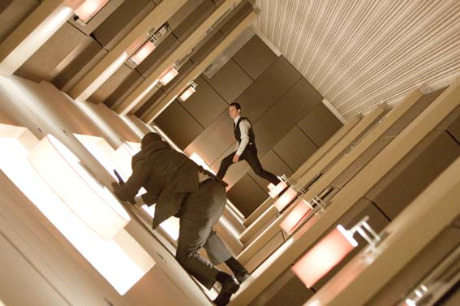
 Ambition has never been a problem for Christopher Nolan. Whether it was constructing an intricate reverse narrative in his hit second feature, Memento, or turning a comic book into a complex, noirish crime epic in The Dark Knight, Nolan is the rare director who manages to make successful blockbusters that conform to an intensely personal vision, no matter how confounding or dark that vision might be. On the one hand, he has qualities of the arthouse auteur, challenging his viewers intellectually. But he’s also a people’s filmmaker, issuing those challenges to masses of viewers who flock to his films in contradiction to popular wisdom that populist audiences don’t like dark or difficult work.
It’s a trick managed by few directors outside of Hitchcock or Kubrick, both of whom are obvious reference points for Nolan in Inception, a labor of love that has taken the director nearly a decade to realize. The care put into all those years of development shines through in every frame.
Inception is Nolan at his very best, a multi-layered, yet singular vision with the considerable resources — both creative and financial — behind him necessary to realize a project this huge. This is a film that takes place mostly in dreams, and the world he creates is utterly convincing as a skewed mirror held up to the real world, the reflection that we create when we sink into sleep.