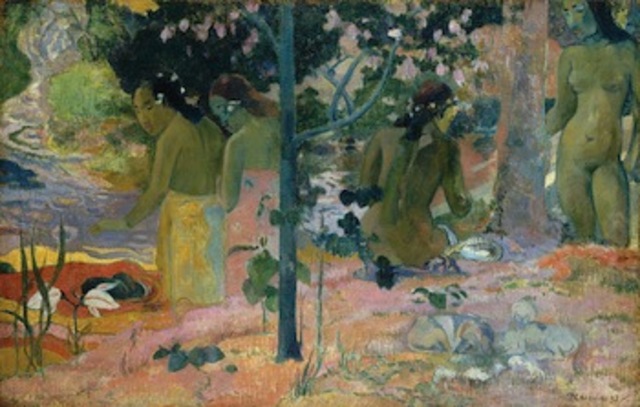
 Image of Gauguin’s “The Bathers” courtesy of the National Gallery of Art.
Flicking through a magazine last week, my eye alighted on an Oreo ad: “Milk’s Favorite Summer Dip” read the slogan near the top, while the image splashed cool blue and white across the page. There’s an up-close Oreo drifting in a mug of milk and two blue straws bending over the edge, looking just like the side-bars of a swimming pool step-ladder. It’s a clever image, designed to dip into the milk-dunking thing but also conjuring up cool connections with summer fun and snacking.
“Milk’s Favorite Cookie” has encountered numerous ad incarnations, all involving the must-add-milk idea, which means they zone well into the zeitgeist of a melting midsummer. Oreo has inspired today’s post, and we’re dipping the Art 2010 toe into Postimpressionism today, with Paul Gauguin (1848 – 1903). Born in Paris to a French journalist father and a half-Peruvian mother, a young Gauguin turned his back on his world as a wealthy, respectable stock-broker and family man to devote his life to art, having piqued his passion by trying out his hand as an amateur artist and collecting Impressionist works.
This was more than taking the plunge into a job: he careered off a cliff into unchartered cultural territories. In a bid to eschew “the disease of civilization,” he sought inspiration and solace among primitive communities in Brittany and Tahiti (he had two extended stays on the island: between the years of 1891 – 93 and 1895 – 1901).
This work, The Bathers (1897), was painted during his second time in Tahiti and suggests the things he was after as an artist. He’d started out experimenting with exotic imagery long before he ever set foot in an exotic place; but these women, with their fascinating faces and beguiling behaviors, brought him into contact with what he called noble savagery: “I have decided on Tahiti…and I hope to cultivate my art there in the wild and primitive state.”