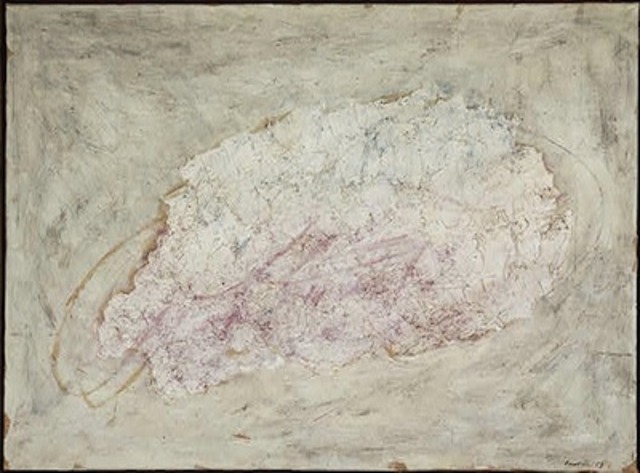
 Image of Fautrier’s Body and Soul, courtesy of the National Gallery of Art.
At the cinema last week, the trailer for a new film Countdown to Zero blasted into the auditorium. Written and directed by acclaimed documentarian Lucy Walker, it traces the history of the atomic bomb, from origins to the present state of global affairs. Walker makes a compelling case for worldwide nuclear disarmament, an issue more topical than ever with President Barack Obama aiming to revive the goal today.
Seeing the trailer jettisoned my mind towards Jean Fautrier (1898 – 1964), a French artist whose works are pitted and punctured in the most profound way by his experiences of war. Fautrier is a fascinating figure: he moved from France to London at age ten and later studied at both the Royal Academy and the Slade School of Art, before returning to Paris in the 1920s to hold his first exhibition.
World War II had an indelible impact on his output: so much of the art that came out of the continent in the post-war years sought to convey the physical decimation, social unease, political division and economic collapse that had happened in Europe. People placed Fautrier as a pioneer of Art Informel (a term coined by the French critic Michel Tapie to describe the spontaneous abstract painting popular in Europe in the 1940s and 1950s), but he himself resisted the label, as he did all other attempts to place him in a cultural pigeon hole.