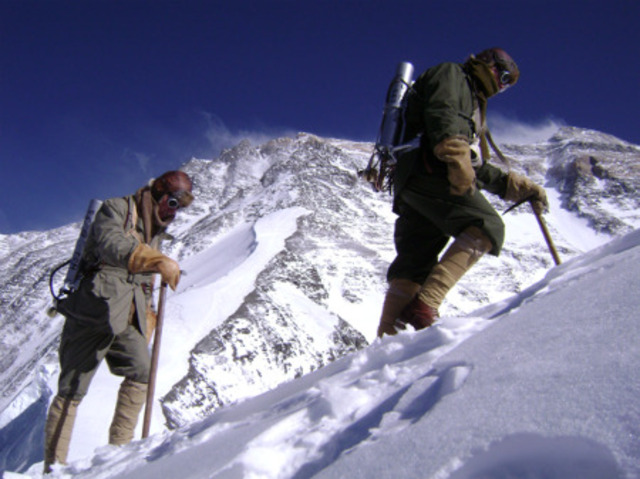
 “Because it’s there,” is the iconic, oft-quoted, and possibly apocryphal answer given by George Mallory when asked why on Earth he’d want to try to get to the top of the 29,029-foot-tall Mount Everest. That was in 1923, when Mallory was on a lecture tour of the United States. He had already ascended farther up Everest than any Westerner ever had, and after one trip on which he mapped out a route to the base, and a second on which many in his party were killed by an avalanche, he was ready to make one last run for the top before he was too old to do it at all.
He was 37 when he made that attempt the following year; he wouldn’t get any older. His cameraman, at a camp farther down the mountain, lost sight of Mallory and his climbing partner, Sandy Irvine, when they were 800 feet from the summit, as the thick Monsoon clouds rolled in. Mallory disappeared, and wasn’t seen alive again.
Wildest Dream opens with a rather clumsy re-enactment of an expedition, 74 years later, during which one of this generation’s best climbers found that generation’s best climber: Conrad Anker came upon the body of Mallory, still frozen in the ice and scree, much farther down the mountain than he’d been last sighted, and it reignited a fierce debate in the climbing community as to whether or not Mallory might have actually been the first man to set foot on top of the mountain after all, perhaps killed on what was otherwise his triumphant descent.