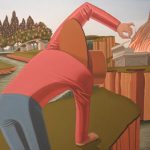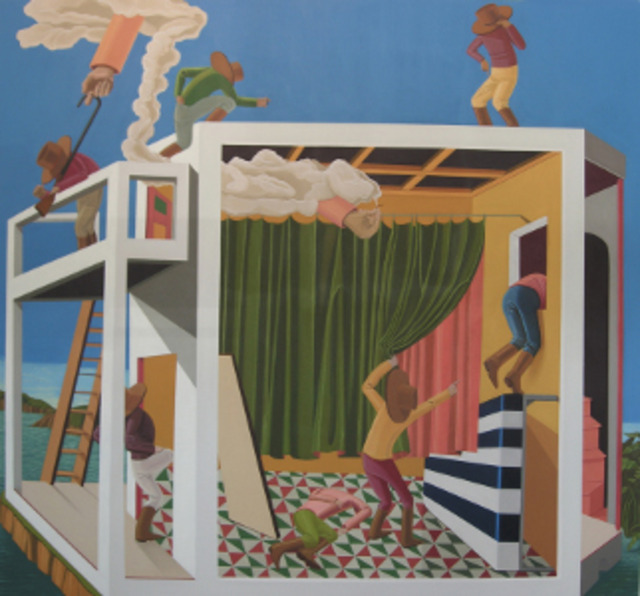
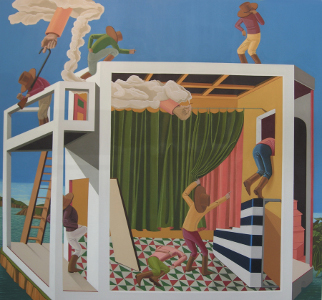
 Image of “Escape from Christmas Island” by Matthew Mann, courtesy of Flashpoint.
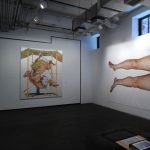
Until the arrival of Giotto di Bondone, artists were esteemed in the way that we now appreciate a good carpenter or a skilled tailor. That is, they were held in high regard as craftsmen, but their names were not part of the cultural conversation. Giotto’s rise to prominence as a Renaissance painter changed all that, and his emergence marks a new chapter in the history of art: the era of the great artist (things have not been quite the same since). He is most notably known for breaking from Byzantine artistic devices to produce a more realistic sense of pictorial space. At Flashpoint, Matthew Mann’s The Cinecitta Chapel, on display through September 4, skillfully ponders on Giotto’s revolutionary sensibility while replacing the weighty religious iconography of the Florentine painter’s work with a lighthearted — although perhaps inconsequential — context of Americana.
The Cinecitta Chapel is an adaptation of Giotto’s fresco cycle from the Scrovegni Chapel depicting the story of Joachim and Anna, parents of the Virgin Mary. Mann’s six paintings correspond with Giotto’s six frescoes, although they’re disjointed chronologically to adjust for a new narrative that borrows from Spaghetti Westerns and cartoon-styled violence. Looney Tunes creator Chuck Jones is listed as an influence, although there’s also visual elements of Spy vs Spy. And the title is in reference to another influence, Cinecitta Studios, where part of Sergio Leone’s noted Dollars Trilogy was filmed.