I hope you’ve been practicing your stitches, readers, since September is National Sewing Month! Observance of the month began in 1982 with a proclamation from President Ronald Reagan declaring it “in recognition of the importance of home sewing to our Nation.”
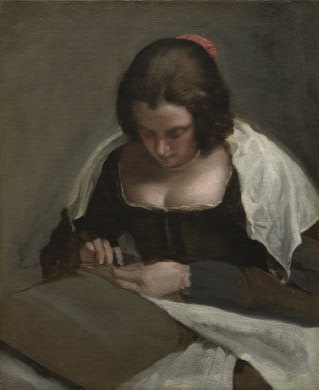 Diego Velázquez, The Needlewoman. Image courtesy of the National Gallery of Art.
To help along all our industrious, craftiness urges is today’s artist Diego Velázquez (1599 – 1660) who’s right up there as the greatest figure of Spain’s golden age of the arts (which reached its peak during the reign — from 1621 to 1665 — of his major patron, Kind Philip IV). By the age of 24, Velázquez was already working as a royal painter: he spent most of his life working for Philip in Madrid, coming up with innovative, excellent portraits of the royal family.
This Needlewoman (c. 1640/1650), at the National Gallery of Art, is of another order entirely: it’s a small and humble work. It is not a bread-and-butter painting for the artist, but rather the kind of thing Velázquez would work on during his down-time, the sort of subject that interested him personally.
A woman sits, head-down, working fabric with needle and thread. It’s quiet and intimate, an effect enhanced by the especial technique the artist is using. Velázquez had looked hard at the visual effects of light on form and doesn’t go in for strong contrasts of light and dark. Instead, at this stage in his career, he’s gone soft, showing a more general glow of modulated light and shade to sculpt that beautiful bosom and shape that graceful face.