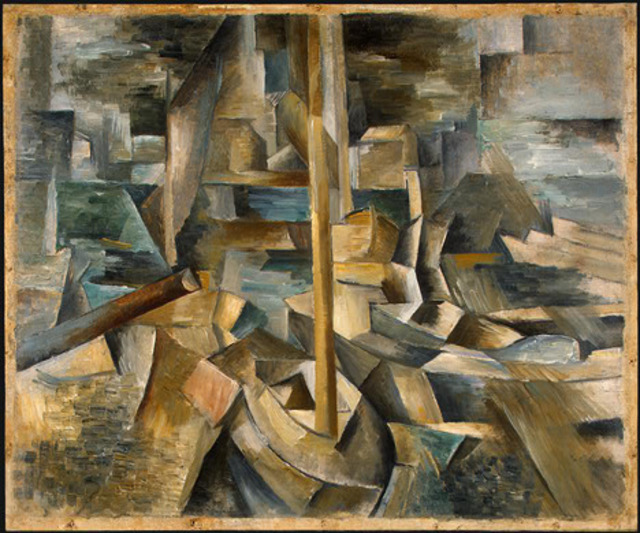
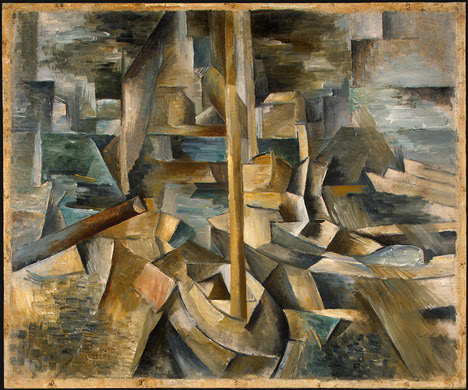
 Georges Braque, Harbor. Image courtesy of the National Gallery of Art.
Fashion and art have long been BFFs, and the relationship won’t be cooling anytime soon. Hot off the catwalk at London’s Fashion Week in September stalked some tremendous “art-dipped” designs for Spring/Summer 2011. Mary Katrantzou offered a baroque, gilded and glittering aesthetic that’d give any portrait of an 18th century aristocrat a run for its money. Felicity Brown bundled voluminous, hand-painted dresses down the runway, inspired (she says) by Toulouse-Lautrec’s women. And Holly Fulton packed some serious art-fashion punch with obvious Art Deco, Bauhaus and Cubism input.
It must be nice to dive into the annals of art history and cherry-pick all the best, most beautiful bits for a fabulous season-full of clothes. In Fulton’s case, I like the way she plays with Cubism’s love of shattered, prismatic forms in her bold, dynamic prints. Look closely and there are even elements of the primitive art that were so seminal for the movement.
Cubism’s splintering of traditional 3D forms and its wild abandonment of the traditional fixed viewpoint that had dominated Western art since the Renaissance shook the tree of art so hard that all the apples fell out. It was a radical and influential style in painting in Paris (1907 – 14) that we all associate with Picasso. But he had an important collaborator in Georges Braque (1882 – 1963), a Frenchman who’d trained as a house decorator before moving to Paris to study art. Braque had a brief foray with Fauvism before two things altered his course: a Cézanne retrospective in 1907 and meeting Picasso, in whose studio he saw Les Demoiselles d’Avignon.