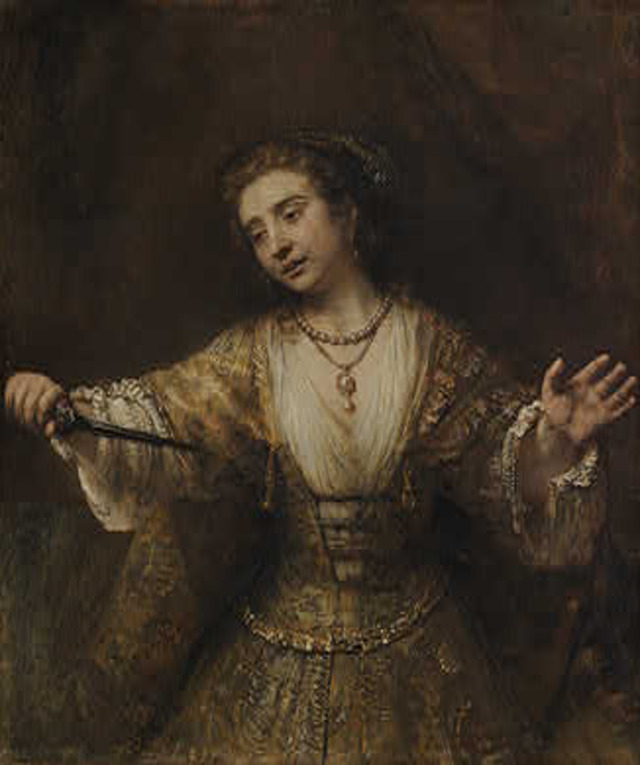
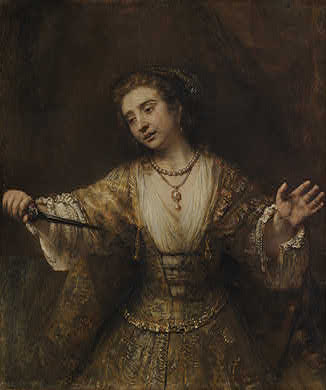
 Rembrandt van Rijn, Lucretia. Image courtesy of the National Gallery of Art.
 This is Lucretia (1664), as painted by Rembrandt van Rijn, housed at the National Gallery of Art. It is, in short, a belter of an oil. She’s the woman who catalyzed the founding of the Roman Republic (so the story goes in the histories of Livy and Dionysius of Halicarnassus). Before this scene, she’s been raped by the king’s son, so she’s about to commit suicide in shame. Lucretia’s assault and subsequent death enraged Romans against the tyrannical rule of their king Lucius Tarquinius Superbus (a.k.a. Tarquin the Proud). As a result, leading families instituted a republic and drove the Tarquin family from Rome.
Rembrandt does the legendary Lucretia proud. He is, of course, the greatest of all Dutch painters (1606 – 1669), famed for his portraiture probably above all. This image is characteristic of Rembrandt’s late period: less of the vivid lighting effects and expressive gestures that came through in his early career, and more marked introversion. Don’t you feel the prickling poignancy of our prying in on this most private moment? It’s too late though, and we must look: the brown background offers no distance or distraction. Though she’s about to stab that dagger, an eery, suspended calm seems to have settled.