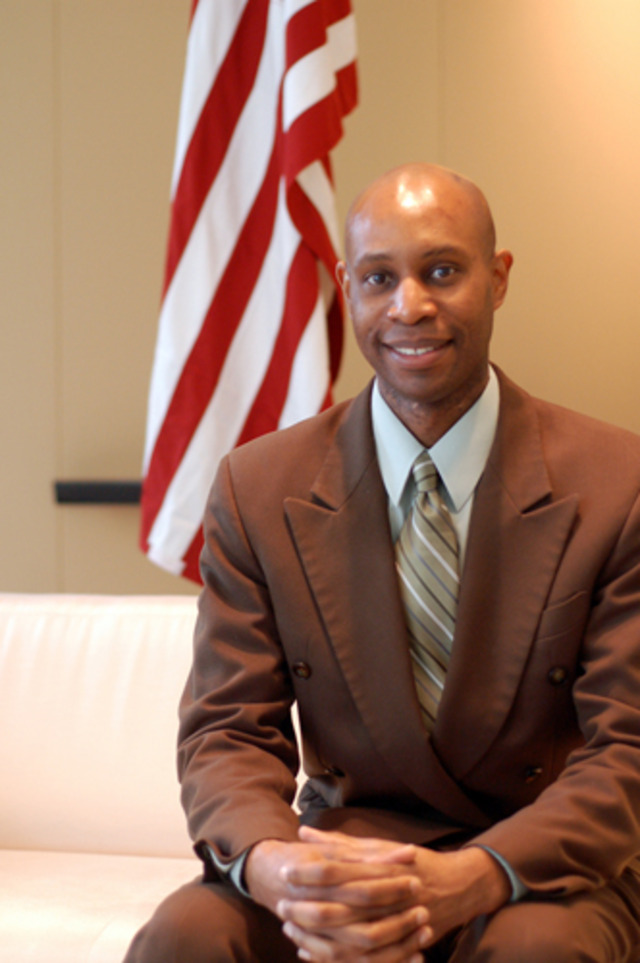
 Photo of Marc Morgan from his website.
You might think that it’d take a little longer than a month and a half, give or take, to change your level of “gay-supportiveness.” (It just doesn’t seem like one of those wishy-washy things you can flip-flop on.) But apparently that’s not the case — as long as you can prove that you’ve got the record.
The Gay and Lesbian Activists Alliance of Washington, D.C. recently released the results of an evaluation which measures how supportive the politicians involved in November’s general election are to LGBT issues. If you’ll recall, the organization also produced a similar evaluation for the candidates involved in the September primary. Most of the candidates have the same scores in both surveys. Vince Gray still stands at +8.5 (the scores are based on a scale of -10 to +10, with more supportive candidates in the positive). Kwame Brown (+5.5), Phil Mendelson (+10), Jim Graham (+10), Harry Thomas, Jr. (+6) and Tommy Wells (+8.5) are all at the same levels that they were back in August. As far as new candidates go, there’s really not much there, unless you consider David Catania (who is gay) and his perfect score a surprise.
But there were some changes. Ward 3 Councilmember Mary Cheh picked up an extra point, moving from +7.5 to +8.5. (I guess that she felt the need to show a little more supports since she now has an opponent, as opposed to the primary, where she ran unopposed.) But the most interesting case is Marc Morgan, the Republican candidate for Ward 1’s Council seat. Morgan scored a +3 in August’s survey. But in this time around, he more than doubled his “supportiveness” rating to +6.5.
Why that’s interesting: Morgan is gay, and worked a strategist for HIV/AIDS and LGBT causes before running for office. So what happened back in August?
Morgan’s campaign manager Nick Jeffress told DCist that Morgan and the campaign were “very satisfied” with the new rating. “We weren’t contesting the fact that other Councilmembers had done tons,” said Jeffress. “But once we had better information about what [GLAA] were looking for, Marc completely redid the questionnaire.”
In August, GLAA said that Morgan “offered no substance in his questionnaire and that he had “only a minimal record.” This time around, the organization was comparably overflowing in its praise, stating that Morgan “agrees with GLAA on the issues and demonstrated a reasonable understanding of them.”
Phew, it’s a good thing that Morgan was able to dig up those records and prove that he cared! Otherwise, we would have just assumed he was less gay-supportive than say, Thomas, who waffled in his stance regarding same-sex marriage before voting for it in 2009.