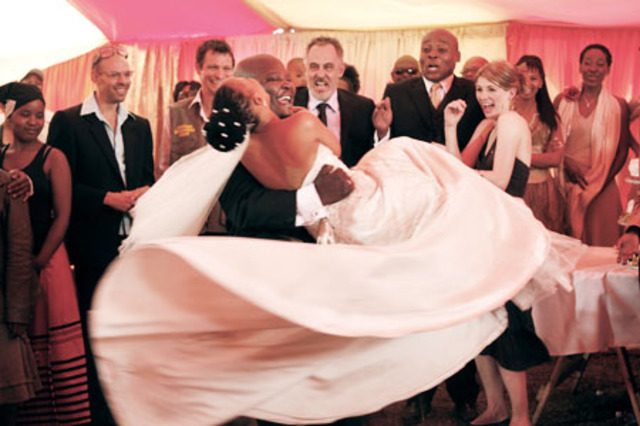
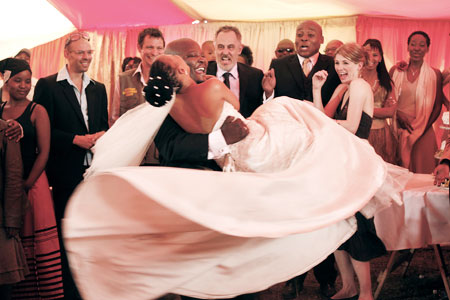
 Upbeat storytelling is difficult to get right. It’s far easier to make people cry than it is to make them laugh — comic timing is an elusive gift possessed by very few people, far fewer than the number that think they have it. But even taking the quest for laughs out of the equation, it’s much simpler to create realistic-feeling tragedies than it is to depict inspirational stories that don’t feel bathetic and contrived. What White Wedding is trying to do shouldn’t work. This is a sunny road comedy, bookended with romance, which attempts to put a hopeful face on the future of race relations in a country where state-sponsored racial oppression is less than a generation in the past.
But the movie manages a sweet and hopeful tone that never feels pollyannaish. On the surface, this is a standard Murphy’s Law road movie: Elvis (Kenneth Nkosi), needs to get from Johannesburg to Cape Town, by way of the coastal town of Durban, for his wedding. It’s a long drive, over 2,000 kilometers, and he has the better part of a week to manage it in. But things start going wrong right off the bat when he misses his bus to Durban, where his childhood best friend, Tumi (Rapulana Seiphemo), is all set to drive him from one end of the country to the other.
Things continue downhill, as obstacle after obstacle spring up to delay the trip: bad directions, worse decisions, confusing road signs, arguments, unexpected stowaways and even a goat. Writer/director Jann Turner’s story is at its best in looking at the 21st century trying to get a foothold in a country where a rural landscape, centuries of indigenous tradition and decades of entrenched colonial racism make social progress as difficult as Elvis’ progress in getting to Cape Town. Turner manages to avoid making overt statements about these issues by using them to support the story, rather than making them the focus.