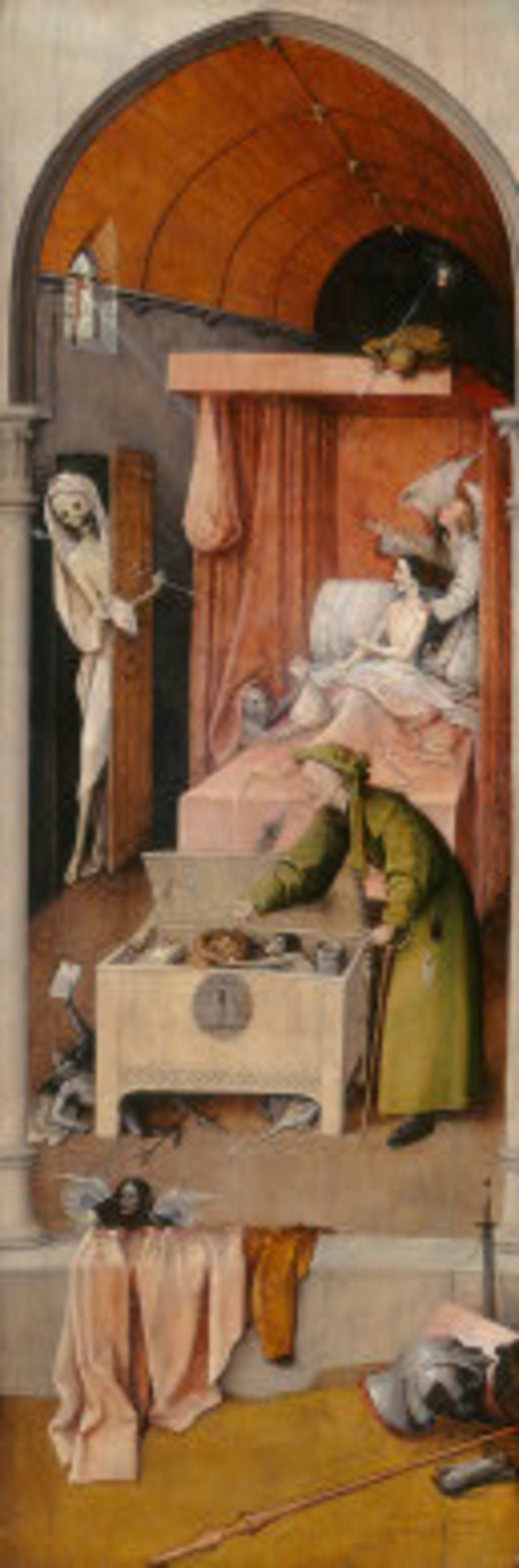
 Bosch, Death and the Miser. Image courtesy of the National Gallery of Art.
Since moving to America, I’d say I’ve definitely had my fair share of steely stares and tell-tale “tsks” – mostly at moments of monetary transaction. You see, for a student-loan beleaguered teacher-type like myself, more than a ten percent tip has taken some serious getting used to.
First I swung one way: determined to fly my British financial flag in the face of what I saw as extortionate tipping, I stuck to my 10% tendencies. That was the stares and tsks time. Not sustainable. So next I went to the other extreme, whispering with a London pal whether we should tip the barista for a mocha. For a couple of weeks there my wallet barely saw the insides of my handbag.
But I’m sticking to the more generous tipping scale, if only because I’ve seen this painting in the National Gallery of Art, and miserly is not what I wish to be. In fact it’s not what I wish my worst enemy to be, if this grotesque and horrifying work is in any way to be trusted. Death and the Miser is by Hieronymus Bosch (c. 1450 – 1516) a Netherlandish painter whose work was popular and influential during the 16th century but then long forgotten. But since his rediscovery at the start of the 20th century, Bosch’s art has both engrossed and grossed-out viewers with its compellingly strange character.
A work like Death and the Miser (c. 1485/90) is infused with all the fragrant fear of hell that haunted the medieval mind. We’re here to witness the dying moments in the life of a miser. It’s crunch time clearly: an angel is asking him to spot the crucifix in the window and a gremlin has pitched up with a final-offer bag of (bad) gold. Skeletal death, with lancing arrow, has just entered stage left.