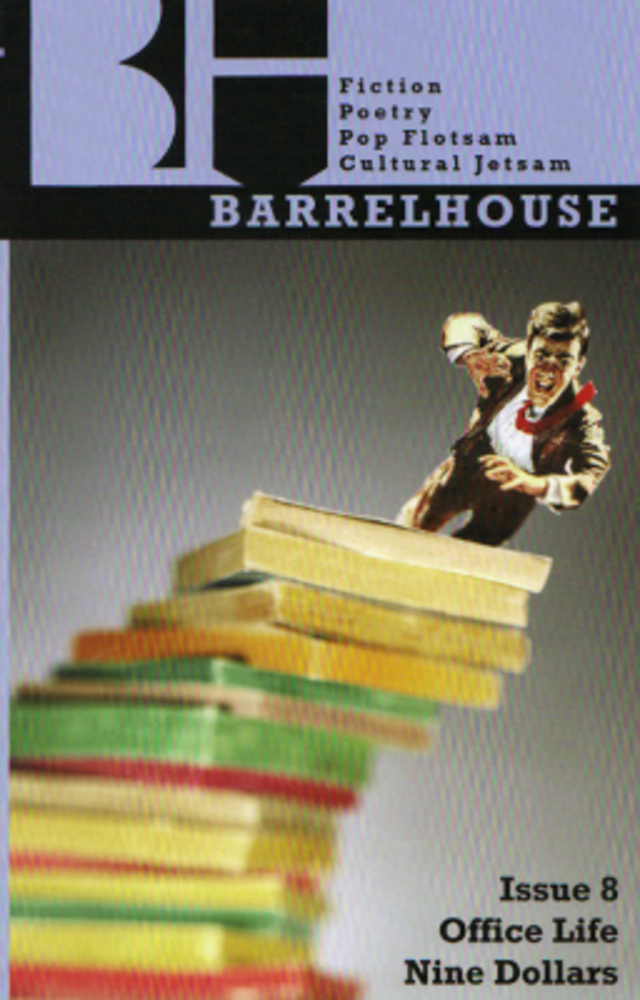
 Barrelhouse, issue 8.
DCist favorites Barrelhouse turned five this year. That’s quite a feat, especially when you consider America’s general disinterest in reading. Barrelhouse’s ongoing success is keeping them busy — in the last three months alone they’ve received close to 900 submissions of fiction, non-fiction and poetry, all of which needs to be read by an editor before ever reaching print. To their extensive to-do list, they’ve added monthly readings at Wonderland (called “Barrelhouse Presents”) featuring writers from other indie lit organizations, like Chicago’s Artifice (last Thursday night) or the small press Dzanc Books (back in July). The idea is to introduce D.C. to the thriving national indie lit scene, and, in the process, lend support to their favorite writers and groups. If you’re interested in catching the next reading you can head over to the Black Squirrel tomorrow night for the Reading to Destroy Language! More events are scheduled for February, so stay tuned to their blog for details. In the meantime, we caught up with the editors of Barrelhouse — there are six of them — to discuss D.C., the evolution of Barrelhouse, and what it’s like to run a lit journal.
I saw that you’ve had close to 900 submissions in the last three months. How much time do you spend reading your readers work?
Dan Brady: Reading is simultaneously the best and worst part of running a literary magazine. It’s at the core of what we do, but it can also be very time consuming, tedious, even boring. That said, when you find something you really love, a writer whose work you really believe in, nothing is better than writing that acceptance email and starting up that relationship. For poetry, I’d say I read submissions a few hours a week to keep up.
Dave Housley: I absolutely agree with Dan that reading is the best and worst part of this thing. It’s a labor of love. We have five editors who read fiction and nonfiction, and we all probably spend five or so hours reading a week. Sometimes more, sometimes less, but there’s almost never a time when we’re not reading something.
Joe Killiany: It goes in phases. I won’t visit the submissions manager for a few weeks, and then I’ll go on a jag and read thirty stories in two days. It’s easier than it used to be; I’m more attuned to what makes a good story and a good essay than I was before reading 500 or 600 pieces at varying stages of development. In fact, it becomes clear pretty quickly what has the potential for publication and what doesn’t.