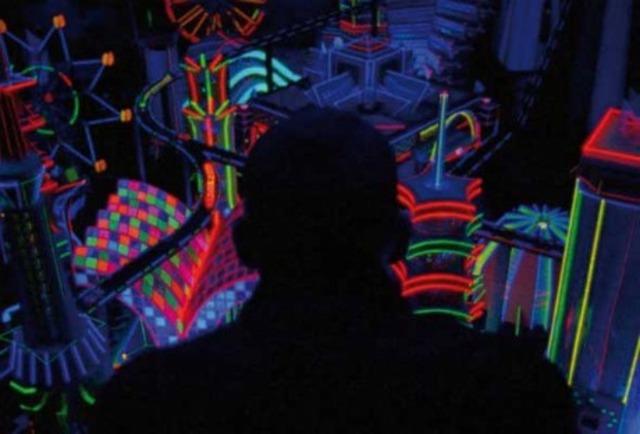
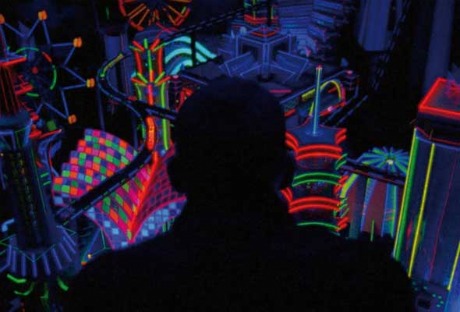
 French director Gaspar Noé reaches out to slap you in the face in the very first images of Enter the Void. The seizure-inducing opening credits sequence is an explosion of color: huge, bold, quickly flashed text, and a constant, nausea-inducing strobe-light effect. It’s as if Jean-Luc Godard, with his predilection for striking credits and intertitles, had decided to make one of his usual sequences while all hopped up on Ecstasy and methamphetamines.
What follows is, similarly, like absolutely nothing you’ve ever seen in the cinema before. It’s tempting to believe that now, over a hundred years into the history of this particular art form, that true innovation within the framework of the narrative film is dead — but Noé shatters that preconception. In exploring one man’s journey after an untimely death, the director does things with point of view filmmaking that are striking in their unfamiliarity. His camera floats, dances and whirls, stitching together real footage with computer-generated imagery in ways that challenge our notion of how cameras can even move.
Every image in the film is seen from the perspective of Oscar (Nathaniel Brown), a young drug dealer living in Tokyo with his sister, Alice (Paz de la Huerta). We see the world through his eyes, and by that I mean not just a point-of-view camera shot, but the closest approximation to the way the world looks through biological eyes as Noé can manage. The camera blinks, it goes blurry in odd ways and behind closed eyelids, there can be entire worlds of light and static.