
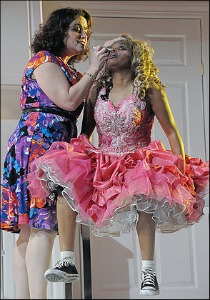
 Emily Townley and Kaaron Briscoe in “House of Gold”.
Woolly Mammoth’s House of Gold is a symphony of creepiness.
There’s the inherent squeamishness that can come from doing a play written about the tragic story of JonBenét Ramsey, the original toddler in a tiara. But more significantly, there’s not a character within House of Gold that doesn’t make his or her own attempt to toy with the audience’s sensibilities, whether it be the suspicious stranger in a van, the socially maladjusted teenager, the mother seen writing fake ransom notes about her daughter or the father telling salacious stories to his little princess.
Your response to the discomfort House of Gold provides will probably have a significant impact on how you view the piece. Disgusted by the exploitation? Filled with outrage and sympathy towards her plight? Genuinely disquieted by our society’s sexualization of the young? Then you might come away with a more fired up reaction; I found mine to be rather hollow.
Benet’s story doesn’t seem particularly timely more than a decade after we learned of the crime, so it’s hard to muster up any “Too soon!” reaction towards House of Gold’s moments of dark humor. Jokes like a mother and father exchange of “What’s in this sausage?,” “Jon-Benet Ramsey” are mildly jarring, but not particularly funny. Additionally, it’s not exactly news that the idea of childhood beauty pageantry is morally questionable. As far as the play’s loose plot is concerned, playwright Gregory S. Moss isn’t so much offering a new theory about Benet’s murder as he is raising several suspicious, and inherently conflicting, possibilities.