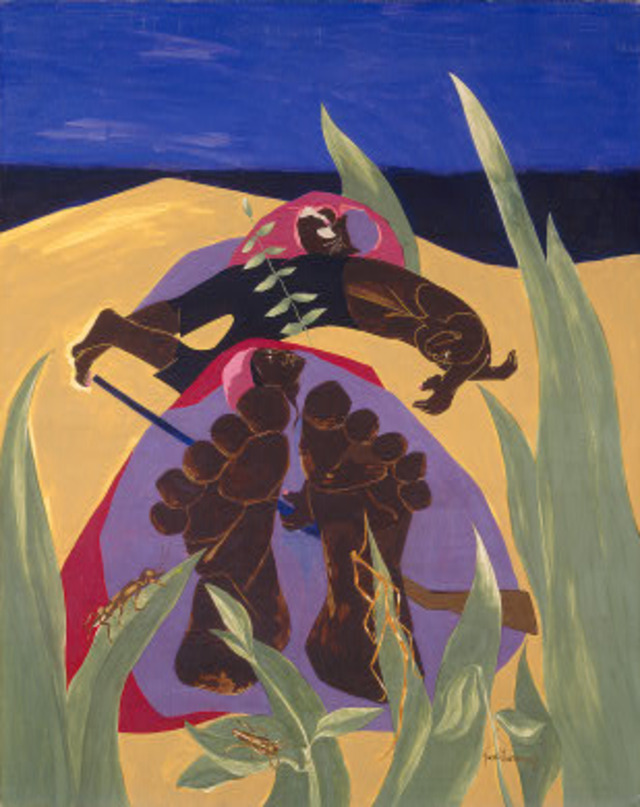
 Lawrence, Daybreak – A Time to Rest. Image courtesy of the National Gallery of Art.
I once read that the key to the power of people-persuasion is the curveball. As in, when faced with a person who isn’t receptive to what you’re saying, going on a tangent or offering some unique unexpected angle on a situation can be the way through a communication impasse. I adore art that persuades with a visual curveball, jolting us upright and making us take proper sustained notice in the process. In the case of Daybreak – A Time to Rest (1967), it’s an enormous pair of hugely disproportioned feet, sitting padded and fat, flush with the picture plane.
The feet are the point-blank focal point here, asking us to step up for up-close consideration. Thin but insistent lines etch across the soles surface, scratching out toes, balls and a matrix of creases. From first look the question crops insistently up: so who do these feet belong to?
Daybreak – A Time to Rest, at the National Gallery of Art, tells one stage in the story of Harriet Tubman, the famed African-American woman who freed slaves using a network of safe houses in the Underground Railroad. It’s by Jacob Lawrence (1917 – 2000), an artist who stuck throughout his career to his campaign to physicalize in paint struggles faced by African-Americans. Here he has Tubman prostate, with a rifle in the crook of one arm. Behind her sprawl the couple with their baby she’s saving. It’s an ardently abstracted image, made up of schematized shapes, jarring colors and a flat-as-a-pancake picture plane.