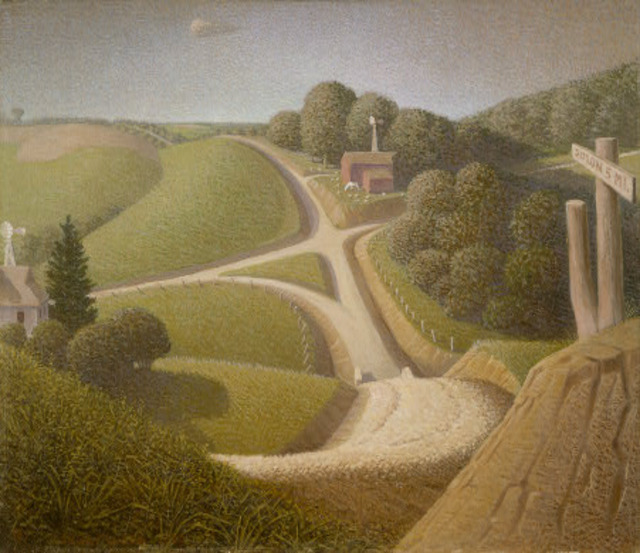
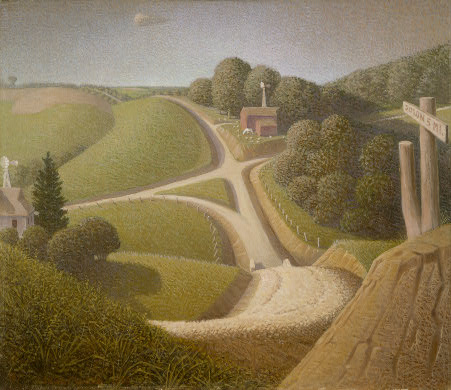
 Grant Wood, New Road. Image courtesy of the National Gallery of Art.
Extensive travel is just one of the perks of art. During the course of this year, I’ve been to places I’m not sure I’ll see again before I expire. Painted pictures at the National Gallery of Art have broadened my horizons, and I still have a few more pit-stops on the traveling train before my year profiling 365 works of art screeches to a halt on December 31. Today, we travel into the heart of America, with two artists who capture the charm of this country with disarming visions. Both Grant Wood (1891 – 1942) and Thomas Hart Benton (1889 – 1975) resisted the trend towards abstraction that dominated American art in the 1920s and 30s; instead, they stuck to the figurative convention, reflecting life in more realistic terms.
Wood became one of the best-known American Regionalists (that is, scene painters), after the enigmatic farming couple in his American Gothic made him a name. The NGA’s work New Road (1939) reveals the influence of Netherlandish Renaissance painting that so much seeped into Wood’s way with paint during his travels in Europe. For instance, there’s a persnickety approach to detail all around: witness the blades of grass, tumbling pebbles, wood grain patterns and rivulet-ridden mudbanks. But then Wood also wants some quantifiable quirkiness in his snapshot of the Midwest: I’m not sure if it’s the soaring rise of the road, the slight soft-focus of the colors and contours or the fable-like feel of the subject-matter, but something makes New Road riveting, despite its (let’s be honest) dull demeanor.