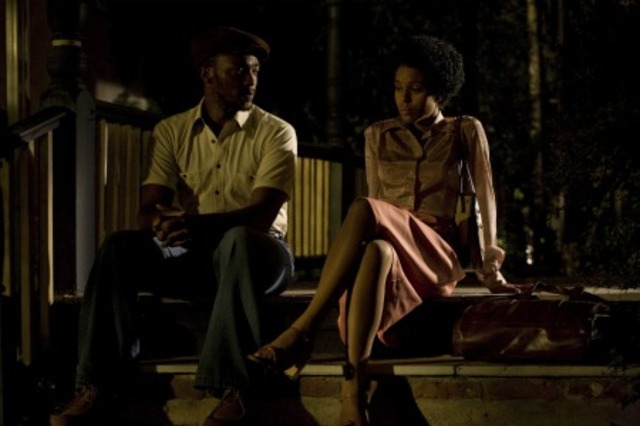
 There is a measured, careful pace to writer/director Tanya Hamilton’s first feature, that belies the fact that there is a lot of violence crowding in the edges. Every once in a while, that violence actually spills out onto the screen, and is all the more jolting for its intrusion into this otherwise somber piece. You knew it was lurking out there, she just lulls you into thinking it couldn’t touch you. That sure directorial hand with tone, and the performances of the leads, are the strongest elements in a sometimes uneven, but fascinating debut.
Hamilton addresses a story here that often gets lost in the endless miles of film shot about the civil rights movement: what was the personal impact of that movement in later years for those who gave up the most in the fight? Set in Philadelphia during the bicentennial summer of 1976, Hamilton lets the narrative unfurl as leisurely as the hot summer days onscreen, with just as much ready-to-boil undercurrent. Multiple characters and strands are introduced before we learn how they all tie together: kids helping an adult collect tin cans, an attractive young lawyer receiving an expensive gift from her older boyfriend and a man with nothing but a duffel bag returning to town for a funeral.
The man in that last scene is Marcus (Anthony Mackie), the center of this story, and the funeral is for his father. But he’s not so welcome here. He’s been exiled from Philly for a betrayal of his friends, and former Black Panther Party cohorts, a betrayal that also involves that lawyer, Patricia (Kerry Washington), her now dead husband, and her young daughter. Getting to the bottom of the story, as Hamilton slowly chips away at the wall between us and these intersecting histories, is a strong pull into the movie’s universe.