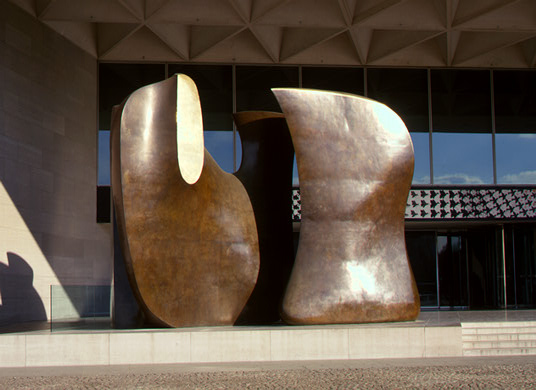
 Henry Moore, Knife Edge Mirror Two Piece. Image courtesy of the National Gallery of Art.
For all the hijinks and jolliness of this time of year, late December can be tension territory. Fun friends or family get-togethers can get altogether less fun when your cousin comments on something she shouldn’t, or brother and sister start bickering about a thing over the brandy butter and mince pies. Putting lots of people into a space and filling them up on food and booze can sometimes add fuel to the fire of seasonal stress, and tips for taking the testiness down a notch are appearing everywhere right about now. The salient point to stick to, I suppose, is that a picture-perfect holiday gathering is a cheesy movie myth, and nothing more. And anyway, it seems that sometimes a little knife-edge tension can actually come out looking rather lovely: Knife Edge Mirror Two Piece (1976-1978) by Sir Henry Moore stands serene and shimming at the National Gallery of Art East entrance, and what an enveloping and evolving work it is.
Born into a mining family as the seventh of eight children, Moore (1898 – 1986) would become the most famous British sculptor of the 20th century. The two subjects that stick out in his oeuvre are the mother and child (which he treated without sentimentality) and the female figure (often looking fluid as a landscape).
Knife Edge Mirror Two Piece perfectly platforms so much of what Moore was about. For a start, there’s truth in his use of materials, so that bronze still looks like bronze (Moore said “stone should not be falsified to look like soft flesh…it should keep its hard tense stoniness”). He’d started his career carving stone and wood, but after the war he began working in bronze, which allowed him to go bigger and better, as here. Cast in several pieces, this piece is punched-through with the very feel and flow of the material.