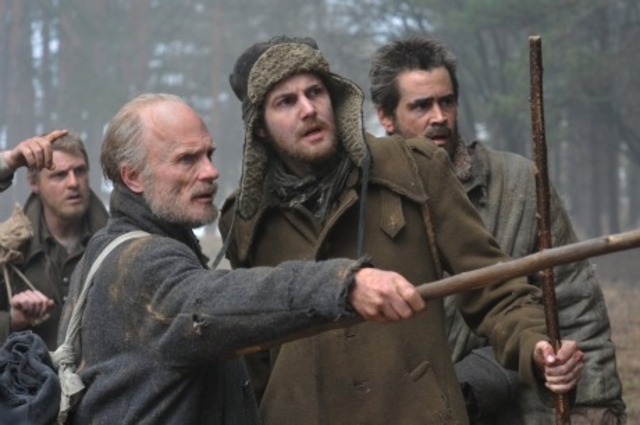
 While watching Peter Weir’s The Way Back, the events depicted onscreen may seem too unbelievable to be true. The point of imprisoning people in Siberia was that the location was itself a prison: there was just nowhere to go for hundreds of miles around. But the group of prisoners in the film, a multinational group of mostly political detainees during World War II manage to escape not by crossing just hundreds of miles, but around 4,000: through Mongolia, China, Tibet and across the Himalayas. If that seems implausible to you, you may be correct: though the film begins with a title card saying it’s based on a true story, the autobiographical novel on which it’s based, Slawomir Rawicz’s The Long Walk, has largely been debunked in its claim to be a factual story. About all that’s reasonably certain is that a group of Siberian prisoners were confirmed to have walked out of the Himalayas into India in the early 40s. Who they were and how they got there is the subject of much dispute.
One should take it as a given, then, that one needs to watch The Way Back with a healthy suspension of disbelief. With that firmly in place, there’s plenty to enjoy in the movie — particularly in its middle portion, as it hews close to the conventions of a bygone era of adventure movies. The first section establishes our mismatched band of travelers as they meet one another in the gulag, centering on Janusz (Jim Sturgess), a Polish inmate turned in for spying by his wife, in a statement forced out of her — whether it’s true or not — by the Soviets. The rest of the group is made up of another young Pole, a Latvian priest, a Yugoslavian accountant, a secretive American and a Russian criminal. Later, they’re also joined on the road by a teenage girl, a Polish-Russian runaway, played by Saoirse Ronan.