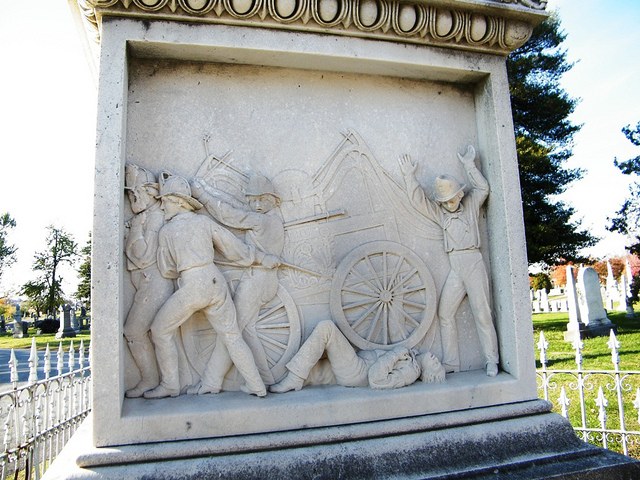
Written by DCist contributor Sarah Stierch
In 1804, if my apartment building existed, my landlord would have to provide leather buckets for each floor in case of a fire emergency. This leather bucket was mandatory — and if your landlord didn’t provide it, you had to provide your own, or you’d be fined $1 for each one missing. (Today that would be about $14 a bucket.) Eventually, the city got a clue and acquired their first fire engine and shortly thereafter, for $300, two more engines in Eastern and Western Markets. Just after 1804, the first fire company was organized: Columbia Firehouse in Capitol Hill.
Volunteer firefighting had formed in D.C. with fierce rivalries and a strong pride for the duty performed by the men who took on the task. In a chaotic political and social time period, territorial battles would commonly erupt, but lives were being saved by men who sought action and heroism.
Until 1856, no firefighter had been recorded as dying on duty, despite violent turf wars and major city fires. That year on May 6, this would change, when a fire broke out at Shreeve’s Stable on 7th Street NW. Columbia Firehouse #1 sent their volunteers to the scene. Amidst the frenzy, screams erupted from one of the water pumpers. A firefighter had been run over by his own engine company. Things took place so quickly – moments later 24-year-old Benjamin Grenup lay dead, crushed under the wheels of the pumper, a vehicle used to pump gallons of water for use during fires.