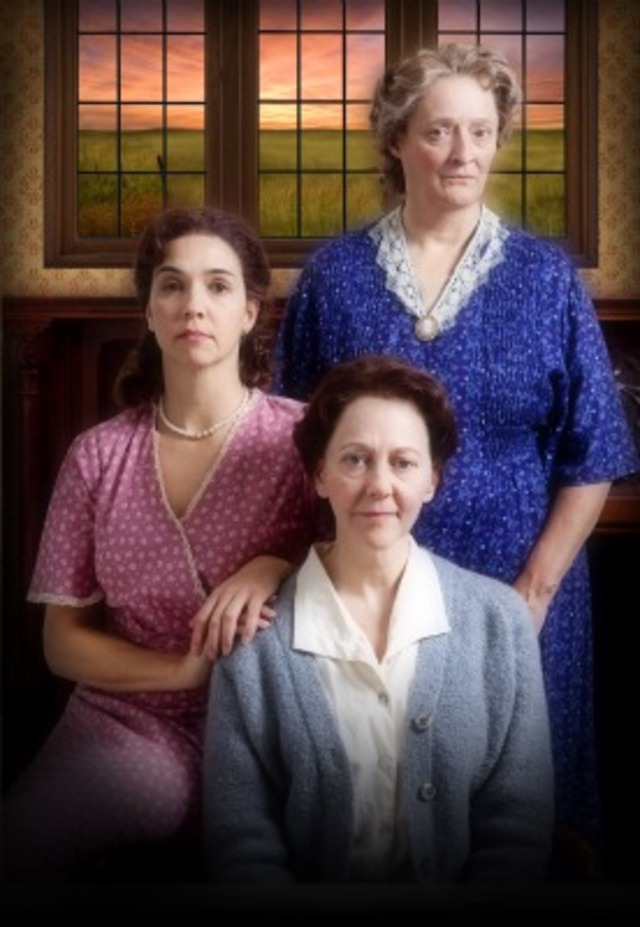
 Holly Twyford, Kimberly Schraf, and Nancy Robinette in Ford’s Theatre’s ‘The Carpetbagger’s Children’
The creaky Pennsylvania farmhouse where my great-grandmother lived, and had since the Depression, had a room that I never really understood when I was young. It seemed to have no functional purpose; you didn’t cook, eat, sleep, or watch TV there. Whatever could it be for? It was, of course, a parlor — a room no one seems to have anymore, the room where you went to sit, and to talk, and to hear stories. That tradition of sitting down and listening to a headful of memories — some wistful, some funny, some tragic — is the experience of Horton Foote’s The Carpetbagger’s Children. Ford’s Theatre serves as rather cavernous version of great-grandma’s parlor.
Now, if you’re looking for dramatic action, look elsewhere. Strictly speaking, nothing actually happens in this play aside from three women taking their turns talking about the past. They’re the titular children, daughters of a Union soldier who relocated to Texas after the Civil War to make his fortune running what would eventually become a massive sharecropping operation, growing cotton on some 20,000 acres of land. If there’s not much drama actually occurring onstage, there’s plenty to talk about: all that land and money in the balance makes certain of it.
The sisters all remain onstage throughout, sitting on furniture that gives the vague sense of the old plantation house, as a gently sloping Texas landscape stretches out into the sunset behind them. It’s a simple, bucolic image, and it, along with the long Texas drawls of the ladies, set up a comforting contrast to a family history filled with severity, distrust, broken promises, and uneasy reconciliations.