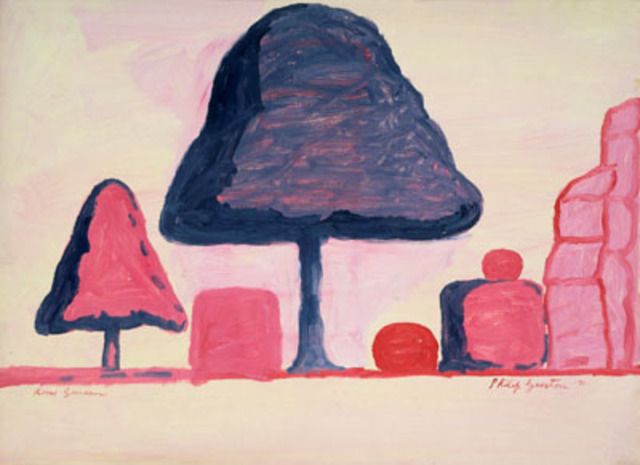
 Philip Guston. Rome Garden, 1971. Oil on paper mounted on panel. Private Collection, Woodstock, NY. © Estate of Philip Guston; image courtesy McKee Gallery, New York, NY
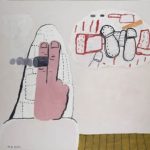
A raw pink foot captured mid-step breathes a dreamlike life to a fragment of ancient Roman sculpture: this is but one of the unusual transformations seen throughout Philip Guston’s Roma and much of his career. With a Pepto-Bismol palette and consciously amateurish execution, like a child who learned to draw from Robert Crumb comics, Guston wanted to paint like someone who had never seen a painting before — and the results are not exactly what fans of Luncheon of the Boating Party think of when they think of the Phillips. But there is a definite charm to the works, a visual innocence that upon further study becomes an obsessive’s anxiety.
Guston’s reputation grew out of the New York School of abstract expressionists; he was a contemporary and friend of de Kooning, Barnett Newman, Pollock and others. But he began to search for what he called “an antidote to abstraction” and in 1970 repaired to Rome after the badly received New York debut of his figurative style. Thus these works are populated with accusing, disembodied Mickey Mouse fingers, Ku Klux Klan hoods, shoe heels, all in that homely palette. The Italian Renaissance may not be the first thing that comes to mind when confronted by these meat-like forms, but the Phillips puts Guston squarely in the context of the masters who inspired him. And Guston himself literally spells out his sources in Pantheon, a stark bulb of inspiration alongside the names of Di Chirico, Tiepolo, and other heroes that is the kind of naive tribute only Guston could devise.