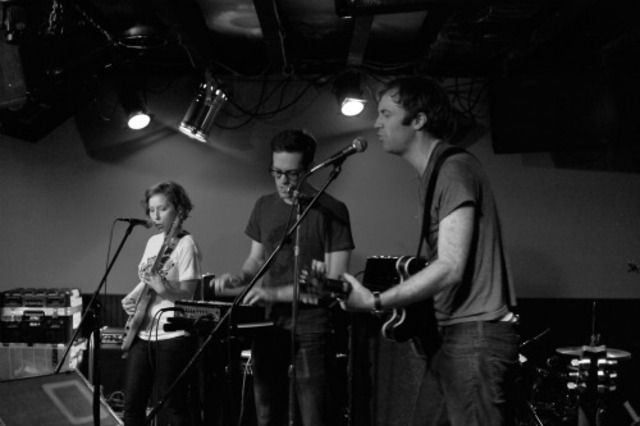
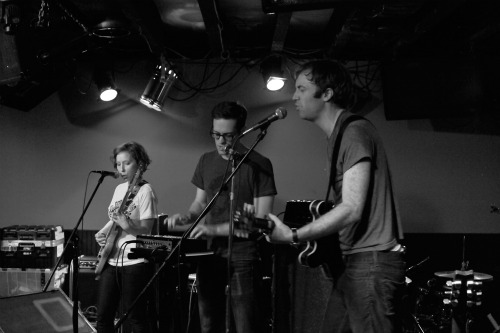
 Photo by Mark Zimin.
When your second-ever gig is opening for a sold out Black Cat Backstage crowd, you’ve achieved in a very short time what takes other bands months or years. Yet, as always, Black Telephone isn’t quite the overnight sensation that it may seem. Thomas Collier (drum machine) has played in Bellman Barker for some time, and Holly Tegeler (bass/vocals) and Rory Carroll (guitar/vocals) were both members of The Surge. And although “Crooked Eyes” started out as an idea for a Surge track, Black Telephone has taken it on a delightful tangent.
The first noticeable component of Black Telephone is their interesting choice of percussion: the drum machine. Yet, what’s usually used to make dance beats or add texture to dense musical compositions actually provides the backbone for well-crafted jangly pop. The melodies are simple yet engaging; the harmonies between Tegeler and Carroll, even more so. We exchanged e-mails with Tegeler and Collier this week to talk about their instrument choices, their experiences playing in D.C. and covering Mclusky.
Find them online: On Facebook.
See them next: This Tuesday at the Black Cat, opening for (The Sounds of) Kaleidoscope.
How did you three meet each other?
Holly: Tom and I had been dating for a while and he’s played music around town, and I sing, but we never played in bands together. Rory and I played together in a different band a few years ago, then had the bright idea to start something up with Tom.
Interesting story: one of the first things that pops up when I google “Black Telephone” is a line from a Sylvia Plath poem. Is that coincidental or is that where you got the band name from?
Tom: Yeah, it’s coincidental.
Holly: Our name came from a song idea Rory had. The name stuck but the song didn’t.
You have an interesting set-up in that your percussion is done entirely by drum machine. Why drum machine instead of traditional drums?
Tom: It started out as a convenient way to not have to travel to the practice space where I keep my drum kit. I sampled those drums and put them on an MPC sampling machine. After a few practices with the MPC, it just seemed like the way to go. Plus, it lets you expand to other sounds as you want to, which I’m still exploring. It looks a little silly, but it’s pretty fun to play.
Your second show ever was a pretty high profile opening slot for The Mynabirds. Was that nerve-wracking at all? Had your songs been written for awhile at this point?
Holly: I was! At that point, we’d been playing together and writing stuff for like 10 months, but we hadn’t played in a venue. Our first show was in our living room. Laura [Burhenn of The Mynabirds] is a good friend of ours and I had shared our demos with her. She was really complimentary and invited us to open the show. Her confidence and enthusiasm helped calm my nerves.
How do you guys write songs? Is there a primary songwriter or is it a group process?
Holly: Rory or I will bring a song idea to the group and we develop it together.
What has been your favorite place to play so far?
Holly: We haven’t had a bad gig yet — everybody’s been really accommodating and helpful. I really do love the Black Cat and I’m excited to be playing there again next week.
One thing I didn’t expect to see when I first saw you guys was a cover of Mclusky’s “Alan is a Cowboy Killer.” It’s a very different sound when you do it; was that part of the appeal of covering it?
Tom: It was just something we came up with because we love the band. The song is great on its own, so it stands up to the more stripped-down version we do.
Holly: Mclusky writes some really rad pop songs. We’re not exactly an aggressive-sounding band. So, it’s fun to connect with people in an unexpected way.
What’s next for Black Telephone?
Holly: We’ve got some fun shows in the works this spring, beginning with the Black Cat Backstage on Tuesday of next week. We’re opening for our friends (The Sounds of) Kaleidoscope.