 There’s a puzzle in Certified Copy that writer/director Abbas Kiarostami doesn’t want you to solve. This isn’t like Inception, where you have a sense that Christopher Nolan knows exactly what happens in the world of the film after the credits have rolled, even if he refuses to spell it out for us. Nor is it like Mulholland Drive, with David Lynch laying out every piece of information needed to solve his riddle and daring us to figure it out. Kiarostami, aware of and fascinated by the inherent artificiality of film, embraces that artificiality to create an impossible scenario, as an avenue to explore aesthetics and emotion.
The film stars Juliette Binoche as Elle, a French woman who lives in Tuscany with her teenage son and runs a small, basement antique shop. As the film opens, she’s attending a lecture by James Miller (William Shimell), the author of a book — from which the movie takes its name — that makes the claim that a there is nothing inherently valuable in a great work of art that can’t be just as valuable in a copy. The Mona Lisa hanging in the Louvre is no better than the reproduction hanging in your living room. If it elicits the same emotional and aesthetic response, why should a copy be scorned; originality is an artificial value that we create.
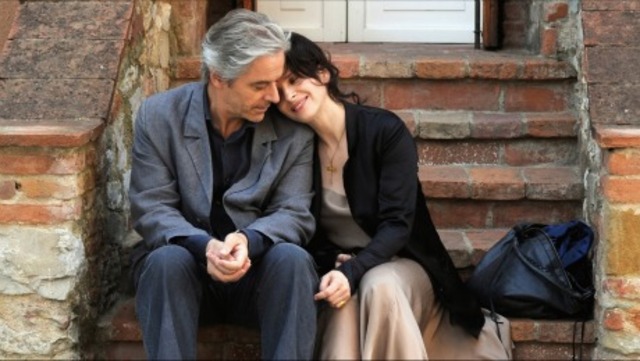
As a dealer in antiquities, Elle takes some issue with his theories, but still is intrigued enough by his thoughts on the matter to arrange, through a mutual colleague, to meet him later in the day. The bulk of the film encompasses the two of them sightseeing around Tuscany and talking. It’s a format that, superficially, reminds one of Richard Linklater’s excellent conversational films, Before Sunrise and Before Sunset. The discussions are just as engrossing, the chemistry of the leads just as inviting.
But at a tiny coffee shop, midway through the film, there is a shift. James tells Elle a story of the indirect inspiration for book, a mother and a son who he always observed walking apart from one another. Elle begins to cry: it’s implied that this is actually a story about her and her own son. James steps out to take a phone call, and the woman who owns the shop begins talking to Elle about James, assuming that he is her husband.
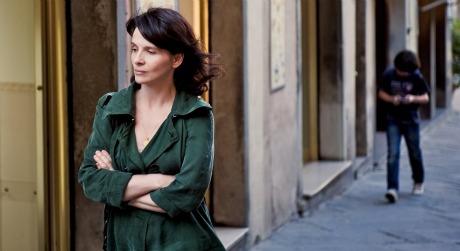 From that moment forward, Elle and James’ discussions become increasingly personal. Instead of acting like strangers, they act as a couple married for 15 years, with him the often absent father of her child. It’s as if the suggestion of the coffeeshop owner that they’re a married couple has made it so. One might think that perhaps this whole exercise has been a game for the pair, playing strangers to reignite their marriage. But Kiarostami is careful to place information early in the film that directly contradicts this theory.
Kiarostami isn’t really interested in whether these two are strangers or estranged. He’s more interested in using them to explore this notion of originals and copies, as well as to probe the mechanics of relationships. Visually, the director insistently pushes “copied” images — reflections — at us. In Elle’s shop, one shot features James talking to Elle as she is reflected in ghostly miniature on a reflective surface just behind him. Later, as they drive around aimlessly — continuing the director’s long-standing love of conversations in cars — the pair is nearly obscured by the reflections of the gorgeous Italian architecture reflected in the windshield. The copies here are given entirely new context and appearance by the motion of the car and the gloss and the contours of the glass.
Even the people they meet along the way are potentially implied reflections. An excited young newlywed couple at a church that Elle claims she and James were married in 15 years earlier could be their younger selves. A tourist couple they encounter could be them 15 years down the road.
Binoche and Shimell are handed particularly difficult tasks, playing characters whose individual histories and shared relationship are constantly shifting and being redefined at Kiarostami’s whim. Binoche is as brilliant, as one would expect, turning on emotional dimes and shifting the tone of her performance with astonishing fluidity. Shimell is the real surprise, a well-known opera singer appearing in his first film role, yet matching up to Binoche’s depth and complexity at every turn.
Kiarostami has spent most of the past ten years away from narrative filmmaking, creating documentaries and works that experiment with form and the capabilities of the moving image to convey ideas in new ways. Certified Copy may represent a return of sorts, to a film that more resembles traditional storytelling — but the structural daring of the director’s work over the last decade is still front and center.
The genius of the film is that he submerges both the formal experimentation and the intellectual investigations beneath genuinely affecting emotions. More than just making you think, he also makes you feel for these characters, despite the impossibility of the scenario, and despite never having a solid idea of who they are. Fake, it seems, really can be just as good.
—
Certified Copy
Written and Directed by Abbas Kiarostami
Starring Juliette Binoche and William Shimell
Running time: 106 minutes
Not rated
Opens today at Bethesda Row