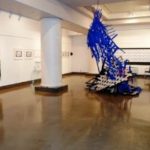
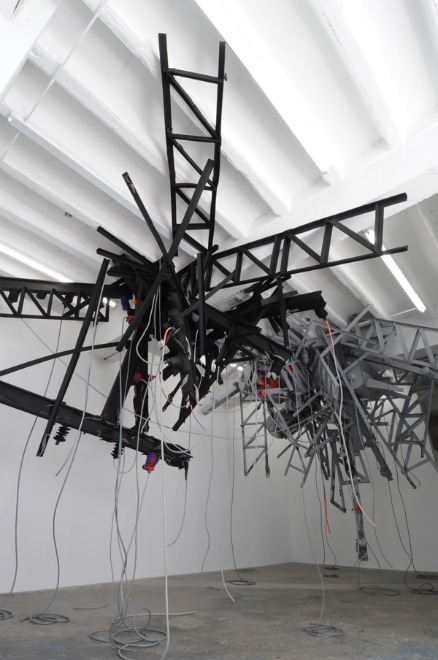
 Mia Feuer, “Stress Cone”, installation view, 2011. Copyright Mia Feuer, courtesy Conner Contemporary Art.
Mia Feuer‘s sculptures don’t care for your personal space. They take inspiration from the inner workings of the urban landscape and bring fractured outdoor structures into the gallery, usually at such a large scale that you’ll have to duck. Her massive site-specific installation at Conner Contemporary Art, Stress Cone, on display through April 30, is no different. All steel beams and cables, it hangs intrusively from the ceiling of the gallery, mangled like the historical detritus of yesterday’s industrial age. It says something about our urban lives — increasingly digital, but reliant as ever on an aging industrial infrastructure. We caught up with Mia to ask her about it.
The work you have at Conner is not the same bright cobalt blue you have used in many of your previous installations, like at Transformer and the Arlington Arts Center. Why the change, and is this the first time that you have worked with these more muted tones?
This is not the first time I built a sculpture that wasn’t painted blue — “Deep Space” is the name of the blue that I have used over and over again. I loved the way that particular beautiful matte blue embodied light — it really glowed. My earlier sculptures that were painted this blue (Collapse or Barricade) were part of a body of work I built that was in part in response to time I spent living in The West Bank, Palestine. The use of blue in these pieces made sense for a lot of reasons, both conceptually and visually. With Stress Cone, I wanted to turn down the volume a little bit. The blue and day-glo orange only appear sparingly. I wanted to there to be moments of intensity and warmth that your eye could rest on amongst the mass of cold flat industrial gray and black.
Your work looks like it’s made of industrial materials, but it’s mostly made of Styrofoam. Why are you using Styrofoam as opposed to other materials?
Styrofoam is a lightweight material that I can easily manipulate and transform. It also allows me to make structures appear heavy, but gives me the freedom to allow an I-beam to fly or a girder to twist and bend. This material illusion allows my work to embody a sense of whimsy. However, Styrofoam is not the only material I use. Steel and found objects also appear frequently in my work. A lot of my recent work investigates urban infrastructure and the human built landscape. The use of Styrofoam rather than steel when creating these constructions becomes a fragile façade that suggests a false sense of security and strength.
Where does the Styrofoam that you use come from? Do you get pre-fabricated components that you then put together to create one of your pieces, or are you polishing and shaping a generic foam block into the form that you want?
Some Styrofoam is purchased from hardware stores, and other pieces are cast foam forms from molds I make, and that material (casting foam) I order online. I do not get pre-fabricated pieces. Everything I fabricate myself in my studio from the raw material.
Does working with Styrofoam limit you to indoor installations, rather than outdoor?
It does not. I have experimented with different materials that can give the Styrofoam a strong plastic coating. This gives the sculpture a plastic shell that protects it from the elements. This coating, in combination with a proper steel armature, can allow outdoor installations to exist.
Yet, to me, your work feels like it’s meant to be indoors — the industrial forms that you create seem to be menacingly invading the pristine, intimate space of the white-walled galleries.
My work comes from places, moments, structures or relationships that are in a state of dissonance, anxiety or strife. The pristine white walls of a gallery allow a contrast that heightens the visual impact of the piece, however I have really enjoyed installing my work in raw spaces (like FLUXspace in Philadelphia) that are quite the opposite [of] “pristine.”
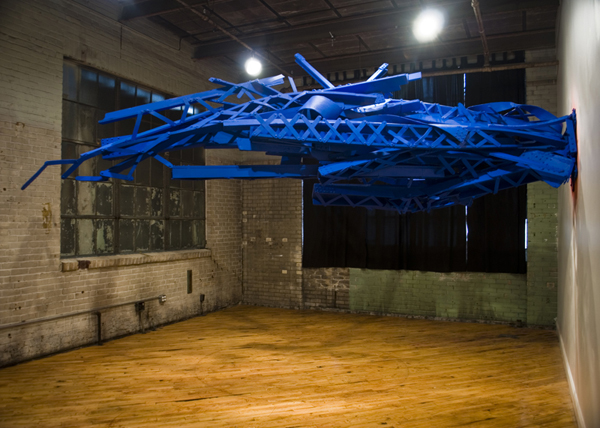 Mia Feuer, “Collapse”, 2009, FLUXspace, Philadelphia, PA. Photo by Diana Cavanaugh.
Is there a certain nostalgia in your work for industrial structures and objects, as we enter an increasingly digital age?
Yes. So much of my work stems from memories of places or structures I have visited. These places include an old iron bridge in my hometown in Winnipeg, an Israeli checkpoint in Palestine, a crumbling fire escape, a traffic jam in a D.C. tunnel. Stress Cone references an old electrical power substation in Winnipeg that I always found as a source for wonder and curiosity. This piece is also an attempt to form a communication with my father who is, and my grandfather who was, an electrician. In this piece I try to speak to them, in their language, using forms and systems that they might understand or identify.
The sculptures that you create are rather rugged, referencing industrial machines and structures that have traditionally been associated with men and men’s work. Is this something that you think about when making and presenting your work?
Gender is not something that I have considered to be at the forefront of my work. My relationship with these industrial structures is driven more by a child’s wonder or curiosity.
Mia Feuer’s installation is on view at Conner Contemporary Art through April 30. Zoe Charlton’s solo show Paladins and Tourists and Coble/Riley Projects video installation Ascension/Immersion are exhibiting concurrently.