Early last year, we told you all about the new Mid-Atlantic Regional Spaceport (MARS). The launch grounds, run in cooperation with the Virginia Commercial Space Flight Authority, is located on NASA’s Wallops Flight Facility (WFF) on Wallops Island, Virginia, about three hours from D.C. on the Eastern Shore. WFF is operated by the Goddard Space Flight Center right here in Greenbelt, Maryland. While WFF is largely a sounding-rocket (research rockets meant for sub-orbital flight) facility, MARS aims to be a heavyweight in supporting the International Space Station. The two launch pads in construction will enable the Taurus II rocket to bring supply payloads all the way to the ISS in low Earth orbit.
I went with my pals at Aviation Week for a tour of the grounds, including a ribbon-cutting to dedicate the Horizontal Integration Facility and a visit to MARS’ two launch pads.
We began at the Horizontal Integration Facility (HIF), where the Taurus II is being assembled. The two-stage rocket was developed by Orbital Science Corporation in Dulles, Virginia under a Commercial Orbital Transportation Services (COTS) contract, NASA’s initiative to develop commercial spaceflight programs that will take over the bulk of our cargo transportation to the ISS once the space shuttle program ends in June. Orbital and SpaceX (which tested its Falcon 9 rocket successfully last December) were the winners from Phase 1 of the competition, and now have contracts for a total of 20 cargo transportation missions to the ISS from 2011 to 2015. You can read more about the program and ongoing phases at NASA’s website.
While SpaceX will launch its rockets from Florida, Orbital will be doing all of its work at MARS. NASA Administrator Charlie Bolden and Senator Barbara Mikulski — a long-time NASA supporter and Chairwoman of the Appropriations Subcommittee that oversees the agency — were on hand to sing the praises of this new partnership with commercial entities and make adorably corny politician jokes. (“We don’t need a Ferrari, we don’t need a Cadillac…we need a Taurus!”) Part of the Taurus II vehicle is being constructed in the Ukraine and will be shipped to MARS for final assembly in the HIF, before being trucked to Launch Pad 0-A and brought to vertical with a hydraulic lift. For engineers or the uber-space fan, you can read Orbital’s full brochure [PDF] on the Taurus II.
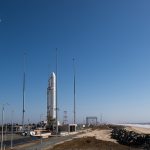
Launch Pad 0-A was our next stop on the tour, which is still under construction. The pad is due to be completed in time for the Taurus II’s demonstration launch in September, with regular missions beginning in December. We ended the tour with a visit to Launch Pad 0-B, more of a launch tower really, which is already completed and in use — it launched a payload for the U.S. Air Force last November.
Representatives from Orbital assured us that the launch of the Taurus II (unlike those of Wallops’ usual sounding-rockets) will be seen as far away as Indiana. Yup, that means that starting in September we’ll be able to view rocket launches from our own backyards and roofdecks. We’ll be sure to let you know when MARS firms up those dates so we can all head outside to watch, or schedule a photo meetup.