Director James Wan has built a career less out of establishing his own directorial voice than out of echoing others. It’s an approach that has yielded mixed results, yet there’s something extra in his movies that make them more than just the work of a faithful copycat. Wan understands something essential in the DNA of the genres he works in that reminds us what makes them such pleasures — guilty or not — to begin with.
Whatever your entirely justified eye-rolling feelings about its six Rube Goldberg torture-porn sequels, the first Saw (the only one that Wan directed) is a grimly effective retread of a Se7en-style industrial thriller. Likewise, the kind-of-awful, yet strangely compelling Death Sentence taps with violent glee into the trashy appeal of ’70s revenge flicks. With Insidious, Wan and his longtime co-writer Leigh Whannell once again resolutely refuse to reinvent the wheel, drawing on sources from classic gothic haunted-house horror to more modern haunting touchstones like The Entity and Poltergeist. But even wearing all those influences proudly on its sleeve, Insidious works on its own merits, because Wan knows that what we’re paying for is to be scared deep in our bones, and that images glimpsed and hinted at are orders of magnitude more unsettling than buckets of blood and viscera.
Wan announces his old-fashioned tone in a brilliantly evocative prologue that finds his camera floating, with a ghost-like menace, around a house while the discordant strings of Joseph Bishara’s soundtrack chillingly recreate the sound of maniacal laughter. (That soundtrack is a masterpiece of sonic manipulation, instrumental screeches, clangs, and dissonance that make this one of the best horror soundtracks since Kubrick tapped pre-existing work from the likes of Ligeti and Penderecki for The Shining.) The title suddenly flickers onscreen in an ominous blackletter typeface; if this was black and white, you could almost mistake it for something out of the 1930s.
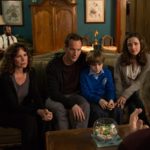
The story is introduced with standard-issue horror tropes. A family has just moved into an old Victorian house with all the genre-standard creaky floors, unoiled hinges and tendency for objects to wind up in places where the new residents didn’t put them. The oldest son, Dalton (Ty Simpkins), falls and bumps his head while exploring in the attic, and something ominous seems just about to happen to him as he groggily comes to. Wan wisely cuts away, and we’re never sure what occurs up there. The next morning, however, Dalton won’t wake up. The doctors claim there’s nothing medically wrong with him; he’s not really a coma, he’s just asleep and isn’t coming out of it.
 His schoolteacher father Josh (Patrick Wilson) and musician mother Renai (Rose Byrne) begin caring for Dalton back at home after three months of continuous sleep in the hospital. And when he moves back into the house, strange things begin to happen: his infant sister’s baby monitor begins picking up strange voices, shadows and faces appear in the windows. In the movie’s absolutely terrifying first real haunting set-piece, entitities seem to assault the house from multiple locations. Wan barely shows anything frightening on-camera, yet there is a breathless chaos in the scene, as Josh rushes around the house inspecting noises, and finding nothing but things like a door flung wide open that he just closed and locked moments before.
In a review a couple of weeks ago, I cited the laughter at a screening of Red Riding Hood as a sure sign of how awful the film was. There was perhaps even more laughter at Insidious, but of an entirely different kind. It was forced, too loud, sometimes happening in a lag after a particularly scary sequence, and prompted by nothing in particular that was happening onscreen. This laughter wasn’t derisive, it was defiant. It was whistling in the dark, a roller coaster shriek transforming in to a gale of laughter because of adrenaline rushes that demand an outlet. Laughter as the nervous assurance that we’re in no real danger.
As if knowing we need this outlet, on the heels of one of the film’s most terrifying shock-cuts, Wan introduces a pair of nerdy ghost-hunters that Josh and Renai bring in, at the behest of Josh’s mother (Barbara Hershey, solidifying the film’s tonal bond with 1982’s The Entity by her mere creepy presence). The bumbling one-upsmanship between the two borders on slapstick; it’s Wan giving us the thumbs-up to take a breather, have a laugh, and turn on the release valves for a few relieving minutes.
The arrival of these two also heralds the weakest aspect of the movie, which is its tendency to explain a little too much. Unlike Poltergeist, which was made more effective by not giving away too much about the place that Carol Anne was trapped, when Insidious‘ equivalent to Zelda Rubenstein’s iconic diminutive psychic arrives, she launches into a long monologue about astral projection, and some nether realm she calls “The Further,” and the whole movie comes momentarily screeching to a bland halt. Wan has a reason for the sudden burst of exposition: the movie is going to spend a good chunk of time in The Further, and he needs to explain the rules; but that doesn’t make it any less flat when he does so.
When the movie shifts dimensions, it comes dangerously close to coming off the rails. In horror, sometimes showing too much can be just as poisonous to good storytelling as telling too much, and Wan tests those limits. But even here, he helps himself out by understanding the value of darkness and not being able to see: though the character who goes into The Further after Dalton carries a lantern, it seems unable to illuminate anything more than a few feet away.
Whannell’s script bucks a few expectations nicely near the end, even as it conforms to others. If there are any third act bumps, they’re more than made up for by these slightly unexpected twists, and by Wan’s skill at making this a good old-fashioned scare-fest, creating fear not with gore and effects, but with clever editing and camera work. It gives Insidious the feel of a film that you’ve seen before, but that you’re more than happy to come back to, because it delivers the frightening goods every time.
—
Insidious
Directed by James Wan
Written by Leigh Whannell
Starring Patrick Wilson, Rose Byrne, Ty Simpkins, Barbara Hershey
Running time: 102 minutes
Rated PG-13 for thematic material, violence, terror and frightening images, and brief strong language.
Opens today at a number of area theaters.