 Anyone worried that a bigger budget, digital effects, and a less personal project might lead Duncan Jones into a sophomore slump can rest easy. The ads may make make Source Code appear to be the polar opposite of his brilliantly understated, cerebral science fiction debut, Moon, but the two films have more in common than one might think; though to go into too much detail on that point would be to spoil some of its immensely satisfying plot twists. Suffice it to say that Jones is no one-hit-wonder, and Source Code shows that he can make an effects-laden action thriller just as thoughtful and engrossing as a meditative one-man show.
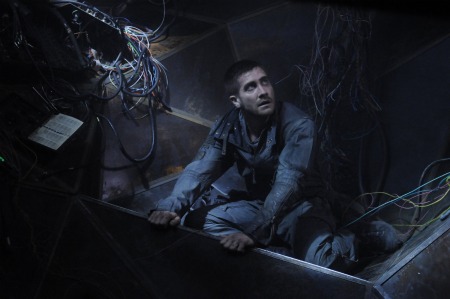
The film stars Jake Gyllenhaal as Colter Stevens, a military helicopter pilot whose last memory before waking up on a Chicago-bound commuter train is of flying a mission in Afghanistan. Eight minutes after awaking on the train, not knowing what’s going on, or why the woman across from him (Michelle Monaghan) seems to know him and is calling him “Sean”, a bomb explodes, killing everyone on board. Except for Colter, who suddenly finds himself enclosed in a capsule of some kind, with an officer on a computer screen (Vera Farmiga) explaining to him that he’ll be going back to the train again and again for those eight minutes as many times as it takes for him to find out who planted the bomb.
This is made possible by a physicist (Jeffrey Wright), eager to prove that his “source code” program — which taps into the alternate-realities potential of quantum physics to send a person into an alternate version of a past event — works. The film doesn’t get into specifics, and doesn’t need to: just enough background is given to make the scenario plausible enough, without overloading the story with too much extraneous explanation.
As in his debut, Jones’ obvious affinity for a too-often neglected brand of idea-driven science fiction shines through. The script, by Ben Ripley, never strays far from familiar genre territory, but that’s no weakness in a film as brilliantly paced and structured as this. Jones masters a rhythmic tension and release, alternating the breakneck speed of events each time Colter is in the alternate reality of the train with the measured isolation and quiet desperation of his confusing situation in the “real” world.
Jones spoke briefly to DCist about the film after a recent screening:
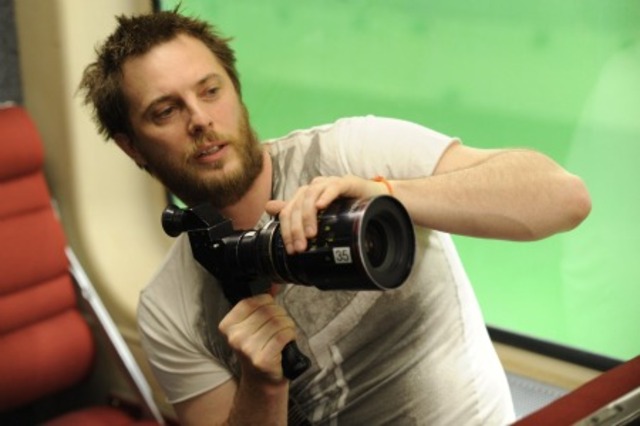
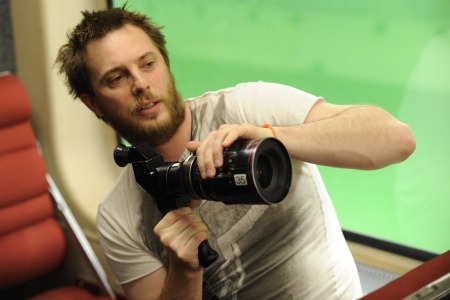 Director Duncan Jones on the set of Source Code.
I found there’s an isolation to Colter’s situation in the capsule that reminded me at times of Sam’s situation in Moon in a number of ways. Did those themes attract you to the script?
When I first read the script, after Jake had given it to me, what I found appealing, and I think that immediately attracted me, were those things that were not like Moon; I was just seeing the differences. I was getting all excited about the fact that this seemed to be like a really pacey, sprawling, sort of action-thriller that had multiple actors and it just seemed so different. And I just felt like I could get my teeth into it, there were things that I could do with it on a visual level that would really be exciting. Also, the chance to work with Jake was a huge draw. Because I had met with him in the first place, just to see what we could work on. But when we started editing the film, it was actually Paul Hirsch, my editor, who’s a legend in Hollywood — he edited Empire Strikes Back and Ferris Bueller’s Day Off, and won an Oscar for Ray — he was the one who actually said, “you know, there’s some similarities here.” So I think although there were things that, consciously, I was very attracted to. On a subconscious level, there must have been things which drew me to it as well.
While there’s a lot more action in this film, I think it definitely fits in with the more thoughtful, idea-driven sci-fi that you were doing with that film, which is a type of science fiction that people don’t really make that much anymore. What draws you to this kind of story?
I’ve always had an interest in sci-fi. What I found fascinating about that particular period [the ’70s] is that the focus always seemed to be more on human questions. The science fiction more surrounded that, and was really a backdrop, a world in which the story and the questions were asked. And in this case, that kind of applies. There is this science fiction conceit, there is this idea at the heart of it, but really, it’s about relationships, it’s about Colter’s character and how he’s able to unravel the mystery that he finds himself in with this mystery dame across from him, Christina, and this one possibly nefarious character, Captain Goodwin, that he has to deal with.
For this film, you had a much larger budget than you had before. How do the additional resources impact your approach to making the film?
Projects tend to swell to the point where the budget never really seems like it’s enough. I was working with a terrific effects supervisor, Louis Morin, and we were really trying to find ways to stretch the budget — even though the budget was obviously much improved compared to Moon — to be able to deal with over 800 effects shots in the movie. So it was finding a way to do that, and at the same time deliver it within the time frame that we had, because we had to shoot the film within the availability of Jake. And Jake had just finished Prince of Persia, and he had the world PR tour that he was going to do for that, and we really had to fit within this window — there was no room to move that around. So as far as shooting days go, it was almost identical in duration to what we had for Moon.
How did you go about approaching the issue of preventing a movie that covers the same eight minutes over and over again from becoming repetitive or monotonous?
That was part of my initial problem. The thing that I had to deal with as a director was to immediately work out how can we ensure that, even though we’re going to be seeing the same event multiple times, the audience doesn’t feel any kind of monotony from that and feel exhausted from having to go back to that event. I had a pretty strategic way of dealing with that, and graphed it out and worked out visually how each one of these could be differentiated and how we made sure that each event itself really sort of propelled the story forward and changed in its own right, so that the audience — although they knew that they were going back to the same event — [had] no sense of having seen it before.
I noticed that you had Scott Bakula from Quantum Leap playing the voice of Colter’s dad, which was a nice reference. Who’s idea was it to bring him in?
[laughs] That was mine. I was reading the script, and it’s obviously a tight and well-written piece, but you can’t help but notice the similarities to other things, and how it references and kind of riffs off of those. And for me, one of the immediate ones — without giving too much away — was the reflection scene in the mirror. I was just thinking, “that’s Qantum Leap, that’s the end of every episode of Quantum Leap.” So when we were trying to decide who we were going to cast for the voice of Jake’s father, I just thought it would be lovely to have a little reference back to Scott Bakula and Quantum Leap at that point. In fact, I don’t know if you picked it up, but he actually even says, “oh boy,” within the context of that conversation.
I know you’ve talked about doing a trilogy of films in the world in which Moon takes place, is that still something that you have on your horizon?
It’s aspirational. [laughs] I’m feeling fairly optimistic that I’m going to be doing a science fiction film next, but I don’t think it’s going to be within the same world that Moon was, it’s going to be something very separate. The film that I was trying to make for a long time, Mute, we have decided to release as a graphic novel. For films which are difficult to visualize, for financiers and people like that, it seems like graphic novels have become sort of the go-to way of convincing them that it will work on a visual level. So, we’ll try that out, make a graphic novel, and see whether that helps that film get made in the future.
—
Source Code
Directed by Duncan Jones
Written by Ben Ripley
Starring Jake Gyllenhaal, Michelle Monaghan, Vera Farmiga, Jeffrey Wright
Running time: 93 minutes
Rated PG-13 for some violence including disturbing images, and for language.
Opens today at a number of area theaters.