 Credit director Joe Wright with trying to avoid pigeonholing himself. His first two films, the period dramas Pride & Prejudice and Atonement, garnered much critical love and comparisons to a previous British master of sumptuous, graceful period pieces, David Lean. Not content to play just to the Masterpiece Theatre set, he set his sights on more modern material — with mixed results — in The Soloist. And now, radically shifting genres yet again, Wright delivers a thoroughly breathtaking, heart-racing international espionage thriller with fairy-tale overtones and a thumping electronic soundtrack from The Chemical Brothers — a band he used to work with in his pre-cinema days directing and crewing rave-inspired music videos that probably inform this work a great deal more than anything he’s done in feature films.
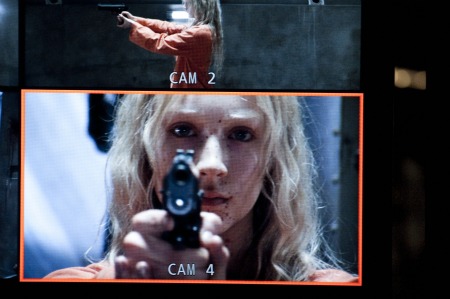
The titular protagonist is a 16-year-old girl (Saoirse Ronan) who starts the film bow-hunting a reindeer in a remote, snowy forest, before engaging her father, Peter (Eric Bana), in hand-to-hand combat when he sneaks up behind her. From his instructions, the fight is obviously part of a training regimen that apparently never ceases. Wright quickly establishes Hanna’s unusual situation: She’s lived her entire life in this frozen landscape, learning to hunt, to fight and to survive. She’s never heard music, never known another human being apart from her father. She is, however, fluent in at least a half-dozen languages — probably more — and has an encyclopedic base of knowledge that comes from, well, the encyclopedias that her father reads to her like bedtime stories.
Despite her isolation, the knowledge from these books gives her just enough information to yearn for another life. She may have never heard music, but she knows how to describe it. Similarly, she’s also able to subconsciously yearn for a break from the pre-determined nature of her existence. When her father reads to her of Laika, the Russian dog launched into orbit in 1957, she bemoans the fact that he always reads it with the dog dying in the end. She wants to change the grim inevitabilities of history as much as she does her life.
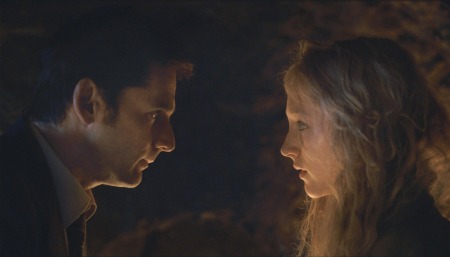 Hanna’s life in the real world begins with the flip of a switch, a transponder signal that her father has instructed her to turn on only when she’s ready to leave the nest. Because the signal lets Marissa Wiegler (Cate Blanchett), a CIA agent who has been trying to track the pair down for a decade and a half, know where they are. Peter knows that Wiegler will hunt them as soon as they come back on the grid, so he figures drawing her out into the chase is the easiest way for Hanna to realize the end result of her training: to become the perfect soldier and the ideal assassin, starting with taking out the woman who wants them both dead.
So begins a relentlessly rhythmic road movie, featuring tense, bracing action sequences punctuated by little breathers, as Hanna curiously investigates a world she knows only from books, making her way from an underground CIA bunker in Morocco where she’s held prisoner by Wiegler, to a rendezvous with her father in Berlin. Along the way, she befriends a young British girl travelling in Morocco with her hippie-ish parents, while trying to evade an assassin, Isaacs (Ryan Hollander), on her tail, an effete, track-suit wearing owner of a club that specializes in transvestite stage shows, who is such a caricature that he’d be absolutely laughable if Hollander didn’t also convey a sense of gleeful, frightening menace worth of A Clockwork Orange‘s Alex.
The plot points are unremarkable and largely predictable, as is the surprise revelation that comes near the end. Seth Lochhead and David Farr’s script is riddled with holes and formulaic turns, as well as a fairy-tale background that is as subtle as a jack-boot to the head from one of Isaacs’ skinhead henchmen. (Yes, he actually literally employs jackbooted thugs. I told you it wasn’t subtle.)
But Hanna works almost solely on the backs of Ronan and Wright. Ronan packs her performance with a frightening intensity that gives way to wide-eyed vulnerability, often shifting back and forth breakneck speed. She’s onscreen for nearly the entire movie, and is such a force — as a young woman to be feared, respected and also pitied for the rotten lot she’s been given — that as the movie ends you still want to spend more time with her. You just might be unable to decided whether to hug her or keep a safe distance.
But ultimately, this is Wright’s film, a clinic in consummate visual stylization and perfect pacing. A film like this demonstrates how, for some directors, story just isn’t as central to their aesthetics as is the look and the feel of the piece. That’s not to say that it’s style over substance, but that the substance is inseparable from the style. It’s why directors like him, or Kubrick or even Lean worked so much with literary adaptations: it’s more interesting for them to shape a proven story to their own needs than to start from scratch.
And in Hanna, Wright demonstrates a savant-like mastery of visual film language, employing graceful, sweeping tracking shots, jittery handheld sequences, extremely intimate close-up moments, and all manner of other blocking and old-fashioned (i.e. not effects-driven) movie wizardry with a mercenary skill focused on making you feel exactly what he wants. Even when the script itself might not be up to the task.
It’s not a movie that’ll necessarily stick with you for weeks after watching, but it is one that will hold you rapt with attention, swept up more than the story should perhaps merit, for every moment you spend in the theater.
—
Hanna
Directed by Joe Wright
Written by Seth Lochhead and David Farr
Starring Saoirse Ronan, Eric Bana, Cate Blanchett
Running time: 111 minutes
Rated PG-13 for intense sequences of violence and action, some sexual material and language.
Opens today at theaters throughout the area.