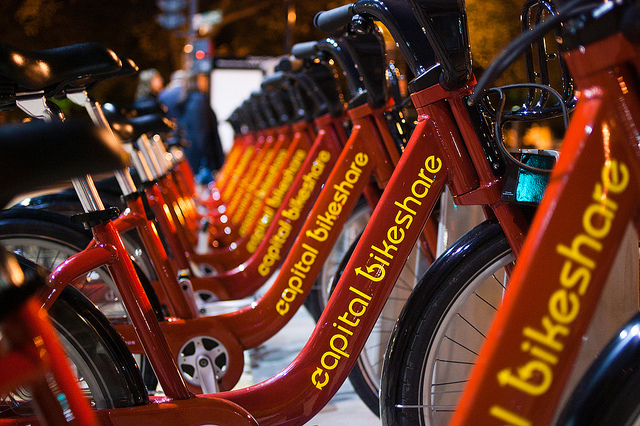
 Photo by Chris DiGiamo.
You may have noticed that today’s featured deal at group coupon website Living Social is a year-long Capital Bikeshare membership for $37. (The tweeting among us certainly did.) It’s a pretty sweet deal — normally, a 12-month membership in the D.C. and Arlington bike-sharing program will cost you a cool 75 smackeroos. Not to mention that such burgeoning popularity for a bike-sharing program is a multimodal transit advocate’s dream. But the deal does bring up an interesting question: will the system actually have enough bikes and docks for all its new members?
Currently, the Bikeshare system has about 1,100 bikes in service at any given time — the exact number at any given second can fluctuate for a variety of reasons. According to the District Department of Transportation, the system boasted “slightly more than 6,400” members before this morning’s deal went live. At post time, the Living Social deal has sold 4,373 memberships — and that’s with two days left in the promotion. That’s some growth.
“We’ve sold a lot of certificates on Living Social today, but not all of those will be redeemed by new members,” explained DDOT spokesperson John Lisle. “We are also seeing a lot of current members buying them to renew their memberships.”
Fair enough. But what about the protestations of those who have tried Bikeshare and found that high-density stations like those outside the Wilson Building fill up quickly or worry about what will happen when the weather gets nice and people want to bike more? Lisle explained that DDOT’s prepared for that.
“Obviously, adding new members will impact the system and increase demand, especially at certain times and at certain stations,” he said. “However, we do have a plan to expand the system to help meet that demand. Both Arlington and D.C. are going to be adding stations and bikes this spring and summer — in fact, the first new ones will be installed before the end of the month.”
Lisle also said that DDOT would be adding docks to popular downtown stations and said that adjusting station size was really not as big a deal as you might think — for example, the incredibly popular Smithsonian station received an infusion of new docks on March 18.
“As we move forward, we can adjust the size of stations depending on the demand — if it’s low we can make the stations smaller and move some of the docks to other locations,” he said. “Either way, we’re thrilled to see so much interest in the system.”