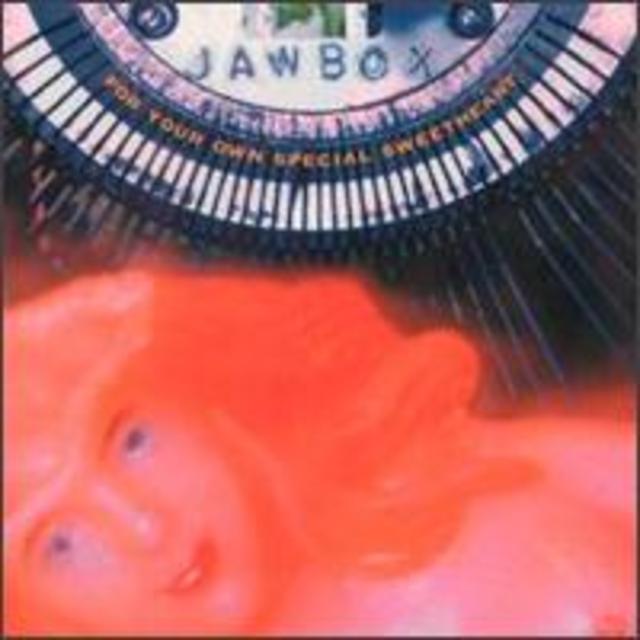
Secret History profiles classic D.C. albums as a way of looking back at the District’s contributions to music over time. This entry focuses on Jawbox’s bulletproof third LP, For Your Own Special Sweetheart (Atlantic, 1994 / Dischord/DeSoto, 2009).
 Jawbox were one of the best-respected and most-loved bands of D.C.’s 1990s indie rock scene, and for good reason. Their brand of intense, intricate and highly tuneful noise was one of the most compelling sounds of the era: a shotgun wedding of power and melody, strength and beauty, bombast and precision. And along with Fugazi, Jawbox were largely responsible for inventing the post-punk sound the city was most closely associated with at the end of the 20th century, skillfully plotting the path out of the hardcore ’80s and into the alternative ’90s.
Prior to forming Jawbox, singer and guitarist J. Robbins had logged time in Government Issue, the longest-lived (1980-1989) of the District’s original hardcore punk bands. After Government Issue, Robbins recruited bassist Kim Colletta and drummer Adam Wade into his new power trio. Jawbox’s 1991 debut LP Grippe set the group’s tone right away, an opening volley of insistent melodies, serrated hooks and hyper-tight rhythms from a band unafraid to let the music breathe and stretch. 1992’s Novelty pushed the sound further, adding second guitarist Bill Barbot.
“Initially I was the only guitarist in Jawbox, and when Bill joined, for a while we were terrible about writing complementary parts,” says Robbins. “When I look back at it, a lot of our creative process was argumentative. Not in a personal sense; we wouldn’t have big arguments at practice. But musically, particularly if I wrote a song, it seemed to me that Bill would write a part that was designed to fight my part as opposed to complement it. And it ended up with something much more interesting because it had this tension and weirdness to it. So, what ended up happening was, since we were both vying for the same space in not always complementary ways, it started moving my guitar playing into more of a melodic area.”
By 1994, Adam Wade had opted out of the group, signing on instead with Dischord label-mates Shudder to Think, whose charmingly twisted Pony Express Record would soon be released on Epic. Zach Barocas took his spot behind the kit, and soon Jawbox was prepping for its third LP, the landmark For Your Own Special Sweetheart.
Prior to Sweetheart, Jawbox had released its albums through Dischord. But following Nirvana’s massive success, and the success of former-underground heroes like Sonic Youth and Dinosaur Jr., the majors soon came courting. Jawbox eventually signed to Atlantic, but the decision to move away from Dischord was a complicated one, according to Robbins. “I had this idea that was really imprinted on me, that to seek rock stardom was intrinsically, inherently a bad thing. Whereas the flipside of that is to be able to make a living doing what you absolutely love the most in the world. People who have successful experiences with major labels tend to be people who are super ego-driven and want to become massively popular, even if they don’t succeed at becoming massively popular. The major label world understands that and they know how to do something with it. Whereas for us, that was never really our style and we wanted to just keep doing what we did, but we wanted to do it with better resources and better exposure.”
“As far as our signing went, friends and family were supportive,” remembers Barocas. “D.C. punk, especially Dischord and Positive Force, had always served as a model of punk independence and community. After we signed to Atlantic and other bands signed to other major labels, that model was corrupted. We knew this at the time but our interest was, as I recall, in having more time and resources available to our art than our then-current situation could provide, which required a shift to a more conventional, mainstream method. The two methods were not always in opposition, but they weren’t always in agreement, either.”
“The thing that always comes to my mind is that when we were talking to [Dischord founder] Ian [MacKaye] about this potential move, he was extremely cool about it,” says Robbins. “He was encouraging to a degree, and he said something which I thought at the time was very wise, and which I now think is even wiser and that we didn’t quite understand. What he said at the time was, ‘If this is a move you want to make, make sure it’s what you really want and really do it.’ And I look back at it and I think there’s a different way to interpret it now. As far as my experience goes and understanding the major label music business, it’s a machine for creating massive pop culture phenomena. So, if you want to be Prince or Madonna, if you want to be the biggest fucking thing in creation and be a household word…if you want to be Lady Gaga, that is absolutely the world to step into. And I think that that’s kind of what he was saying.”
Says Barbot, “I remember this sense of possibility and agitation flooding me: possibility that we too could break into the mainstream and really make a go of this, and agitation that…we might break into the mainstream! It was at once exhilarating and anxiety-inducing. I worried what it would do to the music. Would we carry on the path we were on, making noise for the underground, or would we steer our ship, even unconsciously, toward stiller waters with slicker production, more conventional time signatures, and more pat lyrical content?”
As it turned out, Barbot had nothing to worry about. Far from a mainstream compromise, For Your Own Special Sweetheart is a step beyond in almost every way, upping the ante in terms of complexity, song craft and delivery. This is the LP that finds Robbins, Colletta, Barbot and Barocas gelling at every level, each player operating at the top of his and her game and pushing the others to greater heights. With Sweetheart, Jawbox recorded more than a great album, they created a milestone, a standard by which other D.C. bands would be measured.
A large part of Sweetheart‘s appeal lies in its rhythmic power and complexity. Throughout the album, Colletta and Barocas work together to add dimension to the songs, rejecting standard rock tropes and signatures and hewing closer, at times, to a muscular, jazz-inflected approach. Listen to the heavyweight attack of “Motorist,” or the juggernaut grace of the epic “Savory,” and it’s clear that Colletta and Barocas were key components of the Jawbox magic.
“Sweetheart is the beginning of Jawbox having an idiosyncratic identity as a band, and I give all credit to Zach for that,” says Robbins. “He has so much personality as a player; he was by far the best musician in that band. Kim is an excellent bass player and she writes really cool parts, Bill’s a great guitarist who writes interesting parts, and I write what I write, but I think at that point if you heard any of us play you might say, ‘Okay, that’s post-punk from D.C. or whatever, but have you heard the drums?’ He’s just awesome in that way.
“Up until we played with Zach, we were a real ‘rang-dang-digga-da-dang-da-dang’ kind of drum band,” continues Robbins. “And Zach would have nothing to do with that. Because Zach was such a character, and I’d play this big strummy, chordy song, and he’d be like, ‘I cannot fucking hear myself think! I’m trying to play drums over here!’ And it’s great, because all of a sudden we developed dynamics which we’d never had before.”
“It was not an easy fit,” says Barocas of his joining Jawbox. “We more or less changed our whole approach to performance and songwriting once I was there, in part because I was a jerk, but also because it was increasingly more important to sound like a band working together than a band playing songs together. It’s an elusive difference, granted, but one that I think is clear to listeners and band members alike. My playing on Sweetheart was not different in its approach to my previous work, but it was certainly more sophisticated and aggressive. I had a great deal to prove back then. I was terrified of not making the grade as the drummer of my favorite band.”
Guitar-wise, Robbins and Barbot manage to conjure up a compelling racket, at once hooky and jarring. According to them, much of the their approach was based on their gear. “During Sweetheart, I was basically playing a Mexican Telecaster, with a single coil pickup, through a Hiwatt [amplifier] head, but from the terrible era when Roland owned Hiwatt. It was seriously, like, an amp that the tubes would glow and the circuit board would melt, and then the whole thing would short out, and it just sounded like Cheez Whiz. I was convinced that it was awesome because it was just ear-burningly scratchy and noisy.”
For his part, Barbot opted for Schecter guitars. “Feeling like you’re roaring helps you play like you’re roaring. I couldn’t have come up with the parts I did or played like I did through a Fender Twin [amp] with a Stratocaster. That’s a great set-up, but that sound wasn’t what I was going for. The Schecters and the Marshall JCM800 amplifier gave me the muscle I was looking for. You just don’t write parts like that on an acoustic. Well, maybe Bob Mould does, but I can’t.”
The recording of Sweetheart, completed over seven weeks in August and September 1993 at Baltimore’s Oz Studios with Dischord house producer Ted Nicely, was a difficult process, requiring a level of concentration and attention to detail that at times taxed the band members. “The mechanics of making that record were a total fucking pain in the ass from beginning to end,” remembers Robbins. “Ted was a stickler for tuning and for timing. When I was singing for that record, I was literally punching syllables. My memory of it is Ted going, ‘We need to punch again from the word “be” in the second line because it was flat.’ So I start singing, ‘It will be –,’ and he goes, ‘Okay, good, we got it.’ So unfun.”
“J. and I were in the midst of sorting out this ‘make two guitars sound like one enormous guitar’ problem. That took some doing. Our compositions were dense, and if we had just committed a live performance of the songs to tape, it would have sounded like a murky mess. Ted and we worked hard to figure out how to put the right sounds onto tape to get the desired effect in the mix. It wasn’t like, ‘Songs sound good, press record.’ It was, ‘Songs sound good, so let’s tear them apart and rebuild them.’ It sounds very inorganic, but it wasn’t.”
“I remember seeing Zach throw his snare drum across the studio during a drum take,” reports Robbins. “We thought we were going to be able to take live takes, with us all playing together. But, there were a couple of songs where he ended up having to play the drums by himself. And then he had to play them, like, eight bars at a time. And you could just see the steam coming out of his ears. I remember starting to say to him in the middle of a take that it was going to be awesome, you know, ‘You’re going to get it.’ And he just goes, ‘Don’t fucking talk to me!’ and picked up his snare drum and threw it. It was pretty gnarly.”
Admits Barocas, “I had a difficult time. I had never recorded more than three songs at a time. Some of the technical stuff drove me crazy. I was hostile. I should add, however, that Kim and I were done recording our basic tracks in, like, four days. The rest of the time was spent on guitars, vocals, and mixing. J., Bill, and Ted were very ambitious. Kim and I stepped away from that part of the process.”
Listening to Sweetheart, it’s clear that the blood, sweat, and swears paid off, as the LP ably captures the sound of four musicians working perfectly in tandem to nail the sound in their heads. Track after track testifies to the band’s abilities: timeless single “Savory,” with its abrasive, chiming guitars and effervescent vocal melodies; the roaring “Jackpot Plus!”; the desperate anthem of “Reel,” its tense verses breaking wide open at each chorus. This is 41 minutes and 30 seconds of D.C. post-punk reduced to its most inspiring, powerful essence.
Despite its major label backing, For Your Own Special Sweetheart failed to catapult Jawbox into the mainstream. But the LP made an immediate impression on the indie rock landscape, and over the years it has come to be hailed as a classic of the form. In 2009, Dischord teamed with DeSoto to re-master and re-release the 15-year-old gem, tapping Shellac’s Bob Weston to give Sweetheart a sonic once-over. The results are compelling, especially Weston’s loving attention to the LP’s low-end: the re-mastered drums and bass burst from the speakers much more clearly than before, underscoring Colletta’s and Barocas’s vital contributions.
“It sounds the way I wanted it to sound in the first place,” says Barocas. “Bob’s re-master brought the low-end back. He’s a tremendous engineer.”
Enthuses Robbins, “I think Bob just does such wonderful work. Sonically, the one thing that I would always be bummed about when I listened to the original Sweetheart [was that] the low end is just kind of not there. So, Dischord pitched the idea of reissuing it and re-mastering it. And we thought maybe Bob could breathe some life into this part of the record that we thought got shorted, and I think it’s vastly better sounding. The new version you can really feel like, ‘This is the sound of a band.’ It’s pretty cool. I really am super happy with what Bob did.”
“With Sweetheart, we had the luxury to use the studio as a new instrument for the first time,” says Barbot, taking stock of the LP nearly twenty years later. “It was the first time that I felt we captured on tape the sound we were going for: bigger, complex, massive.”
“For many people, Sweetheart is our catalog,” observes Barocas. “For everybody else, I think it fits nicely between Novelty and [1996’s final Jawbox album] Jawbox. Novelty moved out from Grippe and added two important things: Bill and racket. Sweetheart took the Novelty push for more noise and added some intimacy; it was the first true group effort and introduced me to the fold. Jawbox was the corralling of our energy, the concentration of everything we’d worked up in our time together as a group.”
“I’m amazed that anyone cares and I appreciate it a lot,” says Robbins about the renewed interest in For Your Own Special Sweetheart, evident from the band’s celebrated December 2009 performance of “Savory” on Late Night with Jimmy Fallon. “It’s very weird to me, because I know that just like the majority of bands, all of our records were done by a bunch of dorks bashing shit out in a basement and putting three parts together, and sometimes it sounds more like a song than other times. That’s my knowledge of what Jawbox was like. So, the fact that you’re talking to me about this record now really means a great deal to me. It’s bewildering and it just makes me really happy. Because I know for records that I like, it was exactly the same thing; it was just people bashing shit out in a basement. But those are records that stayed with me. So, the fact that I was the part of something that feels that way for somebody else is pretty gratifying.”