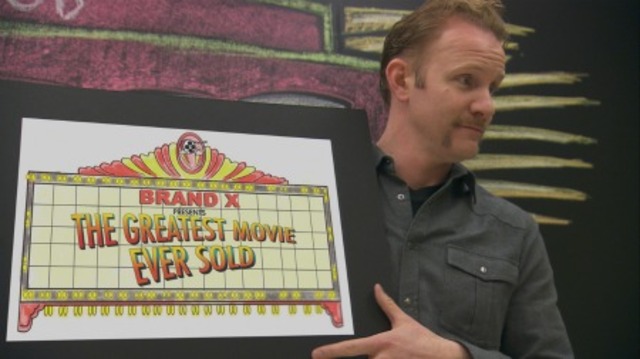
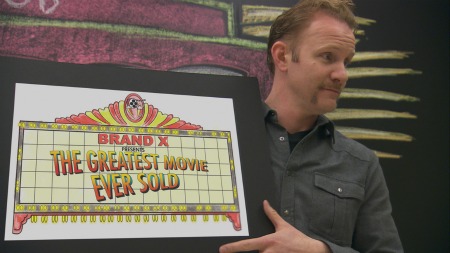
 For his debut exercise in stunt-documentary filmmaking, Super-Size Me, Morgan Spurlock spent thirty days putting a whole lot of beasts in his belly. This time around, he heads into the belly of the beast — to see just how it is that characters in the TV and movies we watch end up drinking this soft drink or using that brand of computer. This being Spurlock, though, he doesn’t exactly go about it in a conventional way. To expose the crass world of product placement, he looks to become part of the machine by funding the entire $1.5 million budget of his film about product placement through product placements.
The vast majority of the movie is about Spurlock trying to get the movie made. He investigates how product placement deals work, and then sets out making cold calls and setting up meetings with potential sponsors, delivering presentations to the likes of Ban, Sheetz, and Pom Wonderful, demonstrating how their products would be represented in the film for various levels of funding. Pom Wonderful ponies up $1 million for the title sponsorship, which also guarantees that all other drink company logos in the movie will be blurred out, and that Spurlock will be drinking their pomegranate juice, ironic wink in his eye, throughout the entire movie. All of this leads up to a whirlwind montage of advertising nirvana in the closing minutes that Spurlock jokingly refers to as being the actual movie that all of this has been leading up to. The whole film is essentially a feature-length DVD extra that exists in order to explain its own existence.
That’s not to say that Spurlock doesn’t include some of the usual investigative documentary techniques. There are plenty of facts and figures thrown out, and side trips into corollary areas of marketing, such as music licensing and school districts that have to sell ad space on their perimeter fence and inside buses just to meet their basic budgetary requirements. And as Spurlock learns from consulting firms about how to determine his personal brand, and how to use that to sell himself as the face of the movie to potential advertisers, he goes out for man-on-the-street interviews asking people about their own personal “brands.”
There are plenty of interviews with the various players in this game — advertisers, marketing consulting firms and biometric researchers who study exactly how to fool the brain into making purchases on one side, anti-corporate and anti-product placement advocates on the other, and film directors stuck in the middle. (Rush Hour director Brett Ratner essentially admits what we’ve all long ago figured out: that he couldn’t care less about artistic integrity as long as his movie gets made. Keep it classy, Brett.)
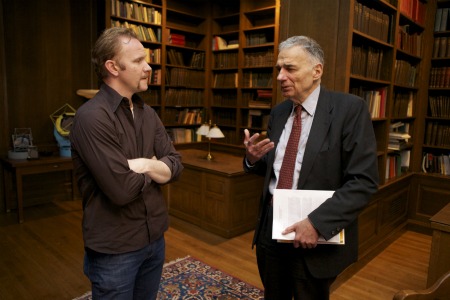 No documentary on the dangers of corporate manipulation would be complete without interviews with either Ralph Nader or Noam Chomsky, of course. Spurlock manages to land them both. Nader actually proves a worthwhile foil for a couple of the movie’s funniest moments. Spurlock, who by this point in the film is in the full swing of whoring himself out for his sponsors, manages to get Nader to participate in an on-the-fly testimonial piece for Merrill footwear, and the normally curmudgeonly activist actually becomes sort of adorable as he plays along here, and in the film’s coda. Spurlock does much the same for anti-product-placement spokesman Robert Weissman, who he interviews in sponsor JetBlue’s airport lounge.
However, none of these informational segments go as deep into their subjects or analyze them as completely as one might hope. That’s always been the legitimate knock on Spurlock: that his films are longer on entertainment than they are on information. That’s certainly true here. The film is incredibly fun to watch, and while the unusually frank inside look at how these product placement negotiations happen is fascinating, each new company he visits doesn’t really provide us with any new insights as much as giving us more opportunity to watch Spurlock engage in his wide-eyed huckster bit.
There’s a delicate dance that has to go on here, because Spurlock is trying to enlist sponsors into a movie that puts on display how sleazy what they do is. That’s a tough sell, and while he often dances up to the edge of damning the process, he always pulls back and softens the blow with a joke. The question is whether Spurlock gives the practice too soft a treatment in deference to his sponsors, or whether he’s just hoping that we’ll read between the lines to see his true feelings.
I’d like to think it’s the latter. Spurlock, much like Michael Moore, likes to play the rube in his films, but he’s obviously worlds smarter than he lets on. Watching his aw-shucks surprise at the secrets of personal branding may be the most disingenuous moment in the film — obviously, this is a guy who has thought a lot about his own image and brand. I mean, can you think of any other explanation for Spurlock holding onto that fu-manchu ‘stache for so long?
So if Spurlock is hoping that we’re just as smart as he is and can read his distaste at the corporate shilling, then we also have to read as disingenuous the crisis of conscience that occurs during the film about whether he’s gone too far over to the advertising dark side. Here, he hits the pavement again, trying to dispel his own personal anxieties about “selling out” by asking New Yorkers what they think of what he’s doing. Who’s he trying to convince: himself, or us? Given the remarkably friendly and reassuring sampling of folks, all of whom assure him that as long as his intentions are true and convictions are strong, he won’t be taken over by his own advertisers, I’m guessing it’s for our benefit.
Even if it’s not to convince us, I’m still not sure how right those testimonials are. Because I do think that Spurlock’s heart is in the right place. But in the race between the movie Spurlock wanted to make, and the one his advertisers would prefer to sponsor, this one’s a photo finish.
—
Pom Wonderful Presents: The Greatest Movie Ever Sold
Directed by Morgan Spurlock
Written by Morgan Spurlock and Jeremy Chilnick
Running time: 90 minutes
Rated PG-13 for some language and sexual material.
Opens today at a handful of area theaters.