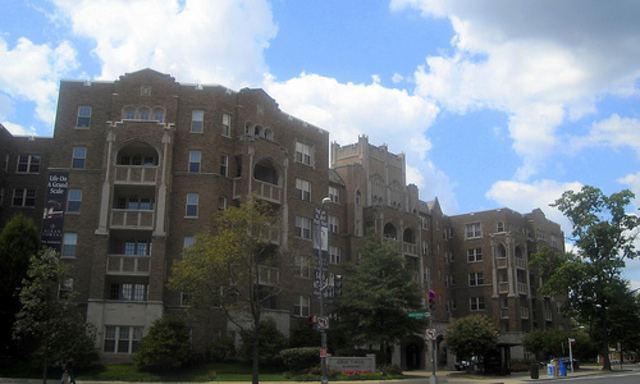
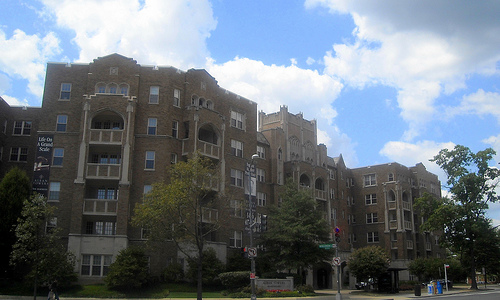
 Photo by NCinDC.
Alban Towers looms large over Massachusetts Avenue. Built in a Gothic revival style in the 1920s, it was one of the first modern apartment buildings built in the city. Starting a tradition of grand common areas, the lobbies and hallways were built with richly ornamented Gothic/Art Deco elements. Paved in quarry tiles of brown, orange, and ocher in a geometric pattern, the lobby is topped by plaster crown molding with rope filled with alternating roses, acorns, and thistles.
Billed as an apartment hotel, Alban Towers offered 24-hour maid service, a public dining room, a beauty shop, a travel agency, a grocery store, and a lunch counter. The apartment building became a popular D.C. headquarters of presidential campaigns, including John F. Kennedy, Eugene McCarthy, Richard Nixon, and Ronald Reagan’s.
The building’s hotel suites were frequented by the likes of Bette Davis and Frank Sinatra.
During World War II, Japanese spies used the Alban Towers residence of the Japanese Naval attaché as a lookout point to the city as well as a place to tap into official radio frequencies.
In the 1960s, the building had declined measurably, due to neglect on the part of the owners. In 1973 Georgetown University bought the property to house students. However, through the 1980s and 1990s the building lay vacant, and fell into a further state of disrepair.
In 1994, amidst plans to demolish the building, area residents successfully lobbied for its inclusion on the National Register of Historic Places, saving it from demolition. The Charles E. Smith Co. bought the property in 1999 and completely restored the building’s common areas. The actual apartments had been demolished by previous owners, so they were completely rebuilt with modern amenities in mind. The total cost of the restoration was $63 million, with the building reopening in 2001.