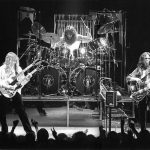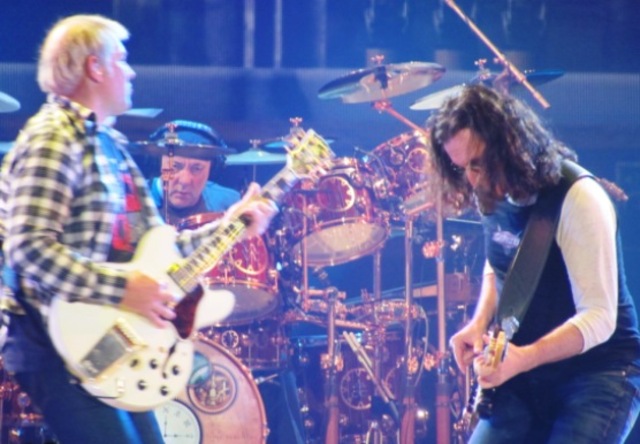
Back in my high school days — the early 1990s — young musicians who were picking up instruments and forming their first bands fell into one of two categories: Rush Lovers and Rush Haters. Standing shoulder-to-shoulder with the former, and like so many drummers who picked up sticks between the mid-’70s and mid-’90s, I spent countless hours in the basement learning the drum parts to Rush‘s many prog rock classics. While my tastes have changed since then, it was with that journalistic bias that I drove up to Baltimore last Friday to check in with bassist/vocalist Geddy Lee, guitarist Alex Lifeson and drummer Neil Peart as they played the 1st Mariner Arena in the band’s only area appearance on the second leg of its Time Machine Tour.
Rush has been prolific over the past decade, after ending the previous one in a down cycle with a five-year hiatus after Peart lost his daughter in a car accident and his wife to cancer in the span of only a year. Canada’s favorite musical export released, supported and put out live albums behind 2002’s Vapor Trails and 2007’s Snakes & Arrows, and ventured on its R30 tour in 2004, which celebrated the band’s 30th anniversary. The trio’s renaissance reached its peak over the past few years when the group started becoming a pop culture reference, with an appearance on The Colbert Report, a cameo in the bromance, I Love You, Man, and being the subject of a well-received documentary.
Opening with the rock standard, “The Spirit of Radio”, the band’s two-set, three-hour performance mined material from fourteen of its eighteen studio albums. A heavy guitar-driven approach has been the Rush sound of late, with Lifeson’s riffs taking center stage. “Far Cry” from Snakes & Arrows, along with “Caravan” and “BU2B” from the band’s forthcoming album, Clockwork Angels, provided Lifeson plenty of room to stretch. The new album reportedly has a steampunk concept behind it, and that theme permeated the show’s visual style.
The night’s centerpiece was 1981’s Moving Pictures, performed in its entirety. Featuring the hits “Tom Sawyer,” “Limelight” and “YYZ,” the recording is Rush’s best selling to date. Deeper cuts like “The Camera Eye” and “Red Barchetta” received particularly strong live treatments, the latter ending with a dextrous bass outro from Lee. “Time Stand Still” — with a sampled vocal from Aimee Mann — and “Subdivisions” were standouts from the group’s keyboard-driven ’80s period, but still sound fresh. The night’s closer, “Working Man” from the band’s 1974 self-titled debut, opened with a reggae intro and then showcased Lifeson’s blazing fret work. Of course, no Rush show is complete with out Peart’s drum solo, a 10-minute percussive extravaganza in which he uses every acoustic and electronic element on his signature rotating drumset, reaching a climax with him playing to the explosive shout chorus from Buddy Rich‘s big band recording of “Love for Sale”.
The most notable change in Rush’s performance style is the way the band has embraced its quirky sense of humor. Monty Python-esque short films opened both the first and second sets (complete with Lifeson in a fat suit), while Paul Rudd and Jason Segel reprised their I Love You, Man personae in an imaginary backstage encounter with the “Holy Triumvirate.” The encore opened with a cheesy circus theme that turned into the instrumental opus, “La Villa Strangiato”. Then there’s the guy in a gorilla suit throwing rubber chickens into the giant sausage maker on stage and…you get the point.
Though highlights were many, even a performance with experienced musicians and great songs will have its faults. The bass sound, in particular, was a bit muddy and failed to cut through the amplification, which is a shame when seeing one of rock’s great bassists. Lee also appeared to struggle with his vocals at times. While the characteristic wail from Rush’s early years has been subdued over time, Lee still tests his voice’s upper limits and, on this night, fell short on a few occasions. Also, Rush’s performances are tightly-scripted affairs, the songs faithful reproductions of studio performances with but a few added embellishments. While this approach guarantees a certain high-quality concert experience, it precludes any happy accidents.
Those shortcomings were minor in the context of what was overall a very good show. Rush Lovers got another chance to see a favorite band, and its nice to know that the guys can still bring it after more than 35 years of playing together. But is it possible that they won over some new converts in its multi-generational audience? Judging by the faces of the many adolescents who were likely introduced to the band via their parents or Guitar Hero, most definitely.