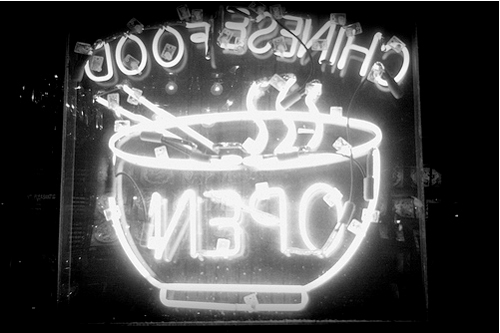
 Photo by Christo70.
Earlier this week at The Atlantic, Damien Ma took D.C. proper and Chinatown, in particular, to task for having a “wholly disappointing Chinese food scene.” And as anyone knows, it’s been like that for well over 20 years, as the area’s increasingly affluent Chinese community fled to the suburbs. Ma rails against the American food chains that have taken over Chinatown and argues that Chinatown could be an ethnic food paradise, recommending that China subsidize restaurants as a method of diplomacy.
I completely agree with the assessment that Chinatown lacks what I consider to be good Chinese restaurants. But this failure is not solely a result of big bad chains pricing restaurants out of the area. This fried good fail is an issue that plagues cities throughout the country. I’ve visited Chinatowns on both the east and west coast, and have found the food at even reputedly good restaurants to be somewhat lacking. Tim and Nina Zagat examined some of the reasons behind this in an op-ed in the New York Times a few years ago. Then, they noted that a significant part of the issue is getting visas to bring highly-trained chefs to the U.S. after September 11, requiring years to assemble a good team. Among the U.S. Chinese community, Toronto and Vancouver are widely considered to have the best Chinese cuisine in North America — commonly attributed to the ability of Canadian cities to more easily import skilled chefs from Hong Kong and China.
Another part of the issue: unlike in the U.S., being a chef in China is not as respected an occupation unless you reach the upper echelons of the profession. As Jen Lin-Liu explained in her book, Serve the People, many of her classmates in cooking school were merely learning the skills to help them acquire gainful employment, rather than chasing the goal of becoming culinary masters. This implies that a substantial number of Chinese immigrants who start restaurants are here to make a living — not to become the Chinese José Andrés.
Finally, the price-cost structure on Chinese food is simply not conducive to the production of reliably high quality food. Chinese restaurants have taken on the role of being the McDonald’s of Asian restaurants. Where else but a Chinese restaurant could you get a protein-heavy lunch large enough for two meals for less than $9? Or consider all those Chinese buffets serving up king crab legs, and mussels for $11.
But that’s what many people expect. For those restaurants to meet those expectations and turn a profit, they disguise lower quality meat and seafood in batter and sugary, gloppy sauces. (Though I do find those renditions to be comforting in their own special way.) And if that margin isn’t high enough, they’ll turn around and open a sushi restaurant, where it’s much easier to bring in the money. (If you walk in to many of the lesser D.C.-area sushi restaurants, you’ll likely be hearing staff conversations in Mandarin.)
In the end, the conditions required to bring better Chinese food to the U.S. — and the District — are manifold. First, lower visa restrictions to import better cooking talent. Second, eaters need to change their attitudes about Chinese food and be willing to pay more for better ingredients and techniques. A meal featuring a single entree at a Korean, Thai or Japanese restaurant can easily set you back $15 or more. Why are we willing to pay more for that often smaller meal than at your local Yum’s?
While none of these suggestions would guarantee better Chinese food around here, it could certainly begin to set Chinese restaurants in this country on the right path.