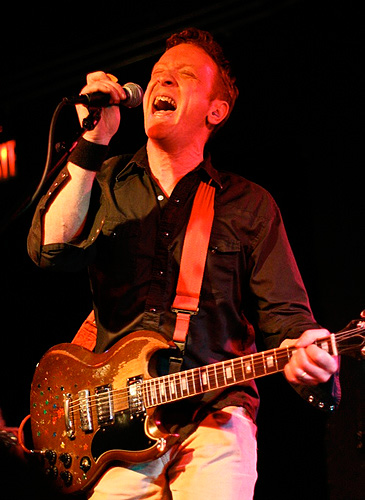
 Bill Janovitz at the Black Cat in 2008.
Formed way back in 1986 as part of the then-burgeoning Boston music scene that would produce Dinosaur Jr., Throwing Muses, Belly, The Lemonheads, Juliana Hatfield and Fort Apache, Buffalo Tom are, to this day, probably known best for soundtracking Angela Chase’s unrequited love for Jordan Catalano on My So-Called Life. After a hiatus following 1998’s Smitten, the band are currently enjoying somewhat of a career renaissance, releasing two of their strongest albums in the last few years — 2007’s Three Easy Pieces and Skins, released earlier this year. Lead singer, guitarist and fellow Red Sox fan Bill Janovitz took some time last Friday to chat with our Kyle Gustafson about the Sawx, Johnny Marr, Mick Jones and the downside of the ’90s alternative rock boom.
I thought we’d start out with the important stuff. RED SOX!
[laughs]
Is the season over already?
Nah. They’re clawing their way back to .500.
So, all the doomsayers are wrong? Will they be okay by the All-Star break? They’re what, like 4 games back at this point?
That’s the thing, nobody’s really taken off yet. It’s a long race. So much of the team was remade, which is not to say that I’ve been able to keep psychologically balanced through the first few weeks, but it is only a few weeks into the season. If they had gone on a nine-game losing streak in the middle of the season, I’d be jumping off the bridge. But it is a big hole to come out of. Luckily, I’ve been so busy lately I haven’t been able to watch every game and get emotionally invested yet. But I got more excited about this team in the offseason than I have in a long time.
So the album, Skins. I think it says a lot that you guys are able to put out such quality work so far into your career.
I guess we look to our role models. Part of it is we took such a long break. I don’t know. Sometimes it’s all about catching — maybe not lighting in a bottle so much as the luck of the draw with whatever you happen to be writing or how the collaboration goes. I started to say I think our role models are people that put out some of their greatest stuff in the middle of their career and maybe even got better. Like Tom Waits, who is probably my favorite songwriter. Tom got better until maybe peaking even recently with Mule Variations. That, to me, might be my favorite record. And there are guys like Van Morrison, who are more hit or miss all throughout their career. It’s not like a comet with a big burst in the front and then a long tail, it’s more like kind of a bumpy snake or something [laughs].
That’s kind of always been the band’s thing. Whenever I talk about Buffalo Tom with my friends, people generally describe the band as “solid.” That you consistently put out good records.
I think we were not prodigies. When you’re around for a long time, you tend to look at your heroes. Like The Stones. They did get better in the middle of their career, before it became a hit or miss type of thing. Bands are different. Especially a very collaborative band like us.
What was the time frame for making this record? A few weeks? A few months?
We had started to go down a certain path and seemed to have a really good head of steam compared to the last one, which was way more “Let’s take out time. Let’s dip out toes in and see if this is still a collaborative writing thing that will pay off.” And I say all this, we don’t really sit down and articulate this stuff explicitly. What that record, Three Easy Pieces, we had taken a relatively long break beforehand and decided to step off the cycle a bit. It was very much a question if we would even regroup anyway.
I definitely thought the band was over at that point.
Yeah, I guess if would have asked me at different points I would have agreed with you. But we were very much keeping it open. There was no singular event that made anyone want to leave the band. It was kind of like “Oh God, let’s just stop this for a while.” Long story short, when we finally did get back into the recording studio, it was very hit or miss. I shouldn’t say that. More like stops and starts. We would write three songs, rehearse them, record them and finish them off. And then in two or three months, we would start all over again. And that had a lot to do with schedules, but it had a lot to do with “How do we feel about the band? How do we feel about collaborating again?” But this one was more, I felt like we had gotten out of the gate with a big head of steam, but it ended up we started in the spring, then all of a sudden, no one is around in the summer. It actually came into question whether we were even going to finish the record. With three middle aged guys [laughs]…
Everyone has kids, I can only imagine the scheduling nightmare that brings.
Everyone has kids, and it’s really hard to figure out what’s going on in each others’ lives. Back in the old days, we’d go away for six to eight weeks and record a record, it was like going on tour.
I did notice that kids and family seem to be a recurring theme on this record.
Yeah, I’ve been saying recently that the music hasn’t really evolved in any big way, if you’re just listening to the music it could fit in between Let Me Come Over and Big Red Letter Day, our mid-period records. But I think lyrically, the themes or the subjects are generally the same, i.e. your relationships, how you deal with them and how that affects you. There’s a lot of adolescent stuff in there. Now, lyrically, it’s a lot more adventurous. Not necessarily autobiographical, but more autobiographical than we have been. Especially with Chris’s lyrics.
You’ve also been doing a lot of writing lately. You have a blog, Part Time Man of Rock, and you also released a 331/3 book on the Rolling Stones. What did you think of Keith Richards’ book?
I really enjoyed it. I was really looking forward to it, because there really have been no Stones autobiographies, nothing from their perspective. I had read Ron Wood’s book, which is hilarious in all the ways you would expect a Ron Wood autobiography to be. Keith’s is the same sort of thing, but a little more insightful. I loved the insights into the songwriting and some of the specifics. I could eat that stuff up all day. I’m not really interested in the gossip so much. But it did strike me as how adolescent he really seems. Really just trapped in this teenage boy jealousy type of thing. I found it really entertaining and was not disappointed at all. Did you read it?
Yeah, I did. I enjoyed it, but he kind of glossed over the drug use. It was like “I went to the bathroom and took a three-hour nap and came out and nailed the guitar solo.”
But I thought one really great nugget about that was he felt like he would take one hit of anything and he would feel good for the rest of the night and other people would get greedy and want to add to it with cocaine, heroin, whatever it was.
When I was reading your blog archives last night, I was really struck about how open and honest it is. It reminds of how blogging was in 2003 and 2004, before everyone got wind of SEO and page rankings. Just people pouring themselves out onto the web. I really enjoyed the post you wrote about being on tour with Big Audio Dynamite and your experiences playing big amphitheaters. I saw you guys on that tour, in Raleigh, and I remember who you opened for, so when you talk about the prima donna headlining band I know who that was. But one thing that struck me in that blog post was you said “Buffalo Tom never intended to be a band that played anything but clubs.” And that kind of made me sad. Because I was so happy for you guys to get that tour and you made it sound like torture. I always wanted you guys to get huge.
Did you read “This Band Could Be Your Life?”
No, but I am familiar with the book.
Because that was the immediate preceding milieu of the context of what we looked at. It was 1986 when we formed. That was Bon Jovi.
Right. Pre-Nirvana. Alternative bands didn’t get big back then.
That was six years before Nirvana. And when you’re in your 20s, that’s a long way to go. When we first started touring, we couldn’t believe that in England they were still concerned about your haircut. The bands that we looked up to, the big bands like R.E.M., they were only at that time breaking into the mainstream. They were breaking through, Husker Du was just signing to Warner Brothers. So, things were changing. The Cure breaking to Top 40 or the Top 100 was a pretty astounding thing.
That book is really great. That outlines the underpinnings of Nirvana and whatever, like the Foo Fighters now. To kind of lay the ground work of the apex, which was Nirvana, and the aftermath. There really was this arc that I never saw coming. The book talks about Mission of Burma, The Replacements, Dinosaur Jr. These bands just touring and touring and touring. And that was it. Right around that time there were a couple of European booking agents that thought “We could get these guys over here.” One thing begat another and that resulted in a bunch of bands really breaking big over there like Throwing Muses, The Pixies, Dinosaur. I remember Dinosaur going over there and then coming back to Boston and playing to me, Chris, Tom and like six other guys.
You guys played a lot in Europe before you even toured the U.S., right?
Well, we started over there. Our first gig over there was playing The Futurama Festival in Belgium with The Stone Roses and Bad Brains to like 10,000 people. That was before we could headline T.T. The Bears in Boston. That changed things and sort of fed back here. So by the time we got onto the Live tour, we were jaded enough to think about “We’re doing this tour to breakthrough. Bands like us are getting played on MTV now.” And that’s why Big Audio Dynamite were on that tour. I was just thinking about this the other day. The Who are on classic rock radio, I’m thinking The Who, The Stones, The Beatles and The Clash. They’re all equals to me. They’re right up there. And here’s Mick Jones of The Clash and I’m watching him every night playing the McMansions, these McDonald’s arenas, cookie cutter Blockbuster pavilions in Nowheresville, America. That was the crux of the whole era. Every band thinking they could be as big as Nirvana, because Nirvana broke through.
I’m a freelance photographer as well. And last year, I got to shoot Gorillaz when they played here. And I passed Mick Jones and Paul Simonon in the hall right before the show and I was like “Holy shit, that’s THE CLASH.” And each time I see them onstage with Gorillaz, I always wonder if Mick Jones ever thought his career would take him to where he would be onstage with a cartoon band dressed in a sailor’s outfit.
[laughs] He was always fun-spirited. If you’re in The Clash, why open for fucking Live, right? I can’t say I spent night after night with him, but there were a few nights where we got into some in-depth conversations and that was my thought. It’s one thing to be in Buffalo Tom, we’re thankful for any gig at this point. We’re five or six years into our career. But to be able to open up for a bigger band, that’s okay. But I gotta say, I went into that tour kicking and screaming. I hated that band. I didn’t want to open for Live. And when they proved to be douchebags, it was kind of miserable.
I’ve never met them, but that doesn’t surprise me at all.
They were total primadonnas. We heard conversations backstage that you would not believe. They came after all that, and totally expected to be U2. They thought they were more important that U2. Not as important, more important. I don’t mean to dis them, but whatever. We just came from really humble scenes, where everyone was humble, and into it for the art. But we got to the end of that tour in L.A., and we were just hanging out. Every night Mick and those guys in the band, they were just good times. They wanted to have a fun time and enjoy life. And to me it was like “Mick Jones, why are you opening for Live?”
Changing gears just a bit, I listened to this really great Morrissey interview earlier this week, and one point he made was that there are certain songs from early in his career that he just can’t sing anymore because they were written by a different person. Do you have any problems playing older material? Obviously, you guys have a very loyal fanbase and while they do want to hear new material, they also want to hear songs from Let Me Come Over.
This ties into the last question of being fans and seeing Mick Jones. If you had ended my career at that point, I would have been happy because I had met and jammed with Mick Jones. But you bring up Morrissey. I’m going to be 45 in June, and we just got back from a trip to the U.K. and Europe in March where they asked us if it was okay if this guy opens for us in Machester and London. It’s Johnny Marr’s son. I’m like “TOTALLY.” Helping Johnny Marr’s family in any way, yes. And so, of course Johnny Marr shows up in Manchester and we’re introduced to him and I delayed going on stage for like 20 minutes so I could talk to him about “How Soon Is Now” and when that song first came on the radio how I was sitting in my suburban living room smoking pot and trying to figure out how many guitar parts are in the song. [laughs]
It comes back to just being a fan. I’m still in it because I love music, the communication, and meeting someone like that in this stage of our career. So getting back to Morrissey, a friend of mine emailed me after seeing us in Boston and he was saying “You guys pay the proper respect to the young men you were when you play these old songs.” The implication is that we don’t want to play these old songs, that we are these different guys. But I don’t think we are. I look at it more like a continuum, like I don’t see this self as different from that self. I’m sure you’re the same way. You don’t look at pictures of yourself and go, “This is some deniable part of who I was.” This is not to say that are songs that I’m embarrassed about and won’t play, because there are, but there is way more stuff that I love to play.
Buffalo Tom play the Black Cat Saturday with Mean Creek. Tickets are $20. Doors are at 9 p.m.