DCist’s highly subjective and hardly comprehensive guide to the most interesting movies playing around town in the coming week.
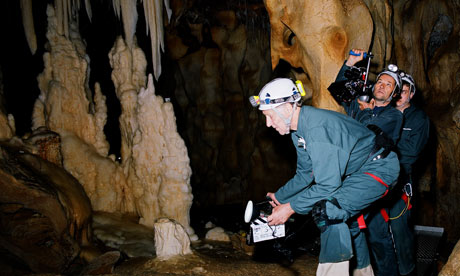
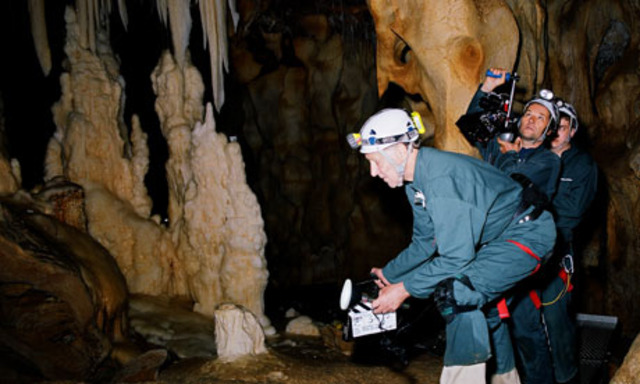
What it is: Werner Herzog’s documentary, shot in 3D, about the oldest known human art, the paintings on the wall of Chauvet Cave in France, some of which are potentially over 30,000 years old (depending on which archaeologist you ask).
Why you want to see it: One might wonder at first, why shoot a documentary about cave paintings in 3D? Is Werner Herzog crazy? The answer to the second question has always been, “quite possibly,” but the answer to the first becomes apparent the first time he trains his camera on the cave walls. Cave paintings aren’t like paintings on canvas: they have the shape and contours of sculpture, and sometimes even use those contours as part of the art. Shooting in three dimensions reveals these works in ways that would be lost in two dimensions, and given that access to the cave is extremely restricted, due to preservation concerns (the only reason the paintings have lasted as long as they have is because the cave was sealed off by natural forces thousands of years ago), this may be the last time a documentation this involved will ever even be allowed in the cave.
Fans of Herzog’s work will find the usual characteristics here: a cast of oddball characters for interview subjects, striking music on the soundtrack, slow, fluid camera movement, his immediately recognizable and soothing voice narrating, and a tendency to embellish the truth for narrative effect. Some people take issue with Herzog’s affinity for blurring the lines between his documentary and his narrative works in this way, but it’s simply a more overt recognition that there is no absolute truth in cinema, not even documentaries. That said, Herzog plays it quite straight for the majority of the film, relying heavily on his idiosyncratic guests to provide interest, and allowing the cave walls to speak for themselves in long, lovely visual reveries. It’s in a tacked-on coda, in which Herzog’s narration takes a particularly poet-philosopher turn, as he visits an artificial rainforest not far from the caves that houses albino alligators where he begins drifting from fact; but there’s a point to this flight of fancy, and in his own weird way, Herzog makes it work.
View the trailer.
Now playing at Georgetown and the Hoffman.
—
The Diving Bell and the Butterfly
What it is: Artist Julian Schnabel’s second feature film, about Elle magazine editor Jean-Dominique Bauby, who became fully paralyzed after a stroke, and was only able to communicate by blinking one eye; in this fashion, he managed to dictate his memoir.
Why you want to see it: Schnabel manages to delve into the memory and imagination of Bauby, making a vivid and visual masterpiece about an otherwise static subject. The result is moving, heartbreaking, and ultimately inspiring. Schnabel will be in town for the screening tonight, and will also take part in a Twitter-based Q&A tomorrow afternoon.
View the trailer.
Tonight at 8:30 p.m. at the Hirshhorn. Free, but advance tickets are recommended. Standby tickets will be available on a first come first served basis this evening. Julian Schnabel will be on hand to introduce the film. For tomorrow’s Twitter Q&A, follow @hirshhorn and use the hashtag #askJulian to ask questions.
—
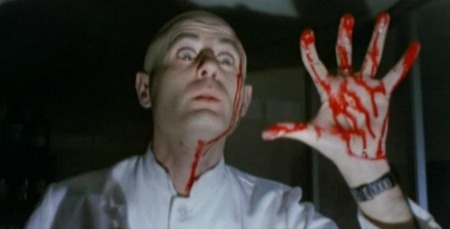
What it is: Nuclear accident creates zombies hungry for human flesh, bloody chaos ensues.
Why you want to see it: Italian horror director Umberto Lenzi directed this cult classic of euro-horror, which, while certainly not the finest example of ’70s zombie movies, has more than earned its cult status. Lenzi reluctantly bowed to producers’ demands for a zombie flick in the mold of George Romero and Lucio Fulci, and Lenzi decided to up the ante from both of them in terms of gore, which Nightmare City has by the bucketful. It seems he was so concerned with the horror effects that perhaps he forgot to make sure that his actors could do more than read lines; the resulting performances are so wooden, it seems surprising the zombie hordes could get any flesh off these people at all. That effectly provides an unintended humor factor that carries throughout the film, making this a great pick for fans of good bad movies.
View the trailer.
Tuesday at 8 p.m. at The Passenger. WPFS screenings are free, but a $2 donation is suggested.
—
What it is: Five programs of children’s international film programming over the course of the next two weekends at a few different venues around the city.
Why you want to see it: Hey, it’s never too early to give kids an appreciation of films from outside the United States. And if your little ones have short attention spans, you’re covered: most of these programs are collections of shorts, so you’ll get a number of different films in any given afternoon/evening.
Opens tomorrow evening at the Hillwood Museum, and continues Saturday at Alliance Française. More screenings to come next weekend as well, at the Japan Information and Culture Center, Goethe-Institut, and Alliance Française. See the schedule for full details. Free.
—
The Silent Musician: How Silent Film Composers Gave Voice to Early Film
What it is: Strathmore Hall presents a program in which Catholic University professor and composer Andrew Earle Simpson talks about how silent film-era composers approached composing music for the movies.
Why you want to see it: If you’ve ever seen a silent film with live musical accompaniment, you know that its an entirely different experience from seeing one on DVD with music chosen for that particular release, particularly if you’ve caught any screenings of films with non-traditional accompaniment that doesn’t restrict itself to early-20th century traditions. Watching those kinds of screenings is a reminder that silent film can be a uniquely interactive and interpretive medium, with the film itself only providing part of the equation. This lecture — which will also include live demonstrations — should provide even more insight in that vein.
Monday at 7 p.m. at Strathmore. $15.
—
What it is: Speaking of silent films, the National Gallery has one of the pinnacles of the medium playing this weekend: Fritz Lang’s classic science fiction fantasy about a dystopian future in which society is divided between workers on one side, and the rich corporate overlords who exploit them on the other. (You know, fantasy.)
Why you want to see it: This ties in nicely with the Strathmore program, as the National Gallery will have the Silent Orchestra, a two-man team of multi-instrumentalists who compose and perform new scores for old silent films, on hand to perform a new score with the film. Additionally, if you haven’t seen Metropolis in the past couple of years, this is the newly completed version, incorporating considerable amounts of previously lost footage that were found in film archives in Argentina and New Zealand in the past few years, which will make it not just a new listening experience, but an entirely different viewing experience as well.
View the trailer.
Saturday at 3 p.m. at the Portrait Gallery. Free.
—
Also opening tomorrow is Bridesmaids, a wedding comedy starring and co-written by Kristen Wiig, directed by Freaks & Geeks creator Paul Feig, and being marketed as kind of a female answer to The Hangover (spoiler: it’s better). We’ll have a full-length review tomorrow.