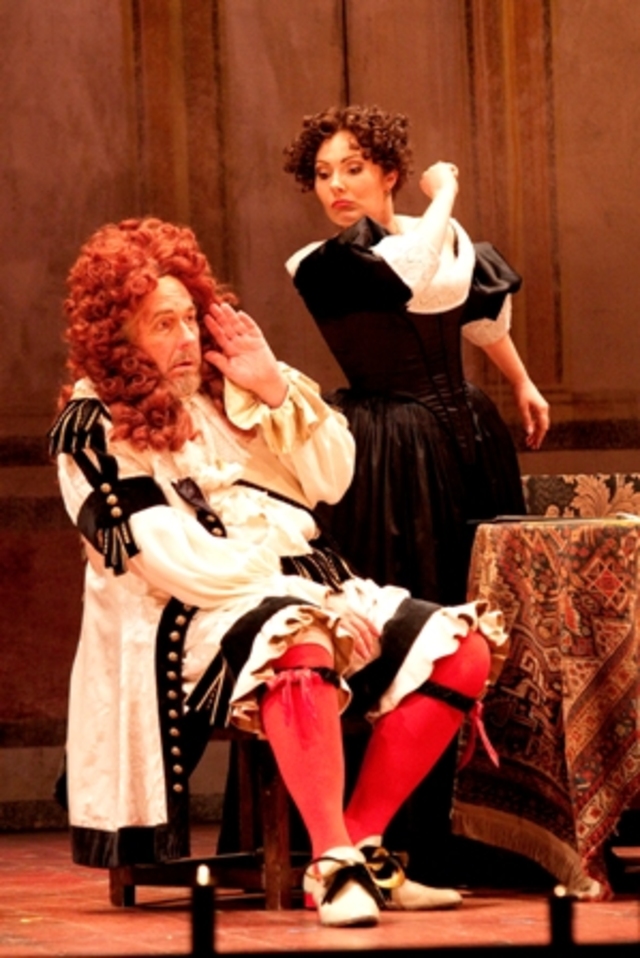
 James Morris (Pasquale) and Ekaterina Siurina (Norina) in Don Pasquale, Washington National Opera, 2011. Photo by Scott Suchman.
Plácido Domingo is taking leave of Washington National Opera in a grand way this month, both on the stage as Oreste in a riveting production of Gluck’s Iphigénie en Tauride and at the podium. Domingo’s contribution on the rostrum in this charming staging of Donizetti’s autumnal opera buffa Don Pasquale is no better than his work there in previous years (balances, ensemble, pacing — so much was wrong with it), but there was nonetheless a feeling of sadness to see him, in all his starry glory, at Friday’s opening night performance and know that it was the end of the Domingo era. Former Washington Post music critic Tim Page’s tribute “Placido Domingo in Washington,” printed in the Playbill program, says all of the positive things that should be said — and none of the negative. Worry not — or worry, depending on how you see things — Domingo will be back as a guest conductor next season, leading performances of Tosca in September.
Perhaps surprisingly at the end of this somewhat rocky season, the situation on the stage was quite good, with the cast led by veteran bass-baritone (and Baltimore native) James Morris, making his company debut in the title role. It is also his first time singing Don Pasquale, a role that is widely regarded as the repertory’s gift to basses at the end of their careers. He was a stitch as the old miser who has to be taught the eternal lesson about the folly of January-May marriages. Much of the gravitas of the voice has faded, but his comic timing was impeccable. Baritone Dwayne Croft, returning to WNO for the first time since Billy Budd in 2004, was a good match for him vocally as the conniving Dr. Malatesta, going toe to toe in the Act III duet, with its pattering parlando.
We remember young tenor and Operalia winner Antonio Gandia when he had a minor role in WNO’s Gianni Schicchi in 2006, and his voice sounded like it has grown comfortably into itself in this turn as Pasquale’s lovesick nephew, Ernesto. He gave a smooth, broad legato tone, with heroic high notes, in all of the gorgeous slow arias, sounding pinched and stretched only in the Act II cabaletta. Having enjoyed the light, airy soprano of Ekaterina Siurina before — on disc with Elīna Garanča and in The Magic Flute in Santa Fe — it was no surprise that she gave a pleasing, fizzy performance as Norina. She was not as vocally vicious as some sopranos in the role, either vocally or dramatically, but her high notes vaulted over the big ensemble conclusions and she was clear and precise with the pyrotechnical work, rounding out a cast that worked well together.
For this production, WNO imported a smart, if low-key staging created by Leon Major for New York City Opera and Glimmerglass. Proceeding from the importance of acting in the duping of Don Pasquale, Major chose to present Norina not as a poor widow but as a disreputable actress. This still made dramatic sense as to why Pasquale would oppose the marriage and seek out his own, but it also added a self-referential quality to the evening, giving the allusions to acting and theater already in the libretto a double meaning. Taking the concept of the mise en abyme and running with it, set designer Allen Moyer created a backdrop that looks flimsily like a stage set, even allowing the viewer to see the wooden supports holding it up from the sides. Cheap-looking backdrops are flown in to create other scenes in front of the single set: a proscenium for Norina’s first scene, set in her theater (complete with a dumbshow, in a commedia dell’arte style, that depicts a woman slapping her jealous husband, action that will be played out later in the staged marriage), and a painted backdrop with a Baroque landscape for the garden scene (not unlike the sorts of backdrops that Rococo painters like Watteau worked on in their early apprentice years). In fact, the artificiality of the staging, its self-conscious theatricality, is related to Major’s choice to move the action backwards in time to the 17th-century of Molière.
This seems to go against most of what Donizetti was able to accomplish with this opera at the end of a distinguish career, as noted by William Ashbrook in his magisterial study Donizetti and His Operas: “Don Pasquale is remarkably free of the multiplicity of stratagems and the abuse of coincidence that are the staple fare of many opere buffe. To an exceptional degree the traditional comic types (the senex amans, the schemer, the soubrette, and the young lover) are humanized in Don Pasquale.” Donizetti had the upper hand on his young librettist, Giovanni Ruffini, as they adapted the story from another libretto, imposing most of his own decisions. Donizetti worked very quickly to prepare the score, including adapting much of his own music from other works in not obvious ways, leading Ashbrook to label Don Pasquale the “eleven-day wonder.”
Major seemed to be interested in flattening the characters back into their commedia dell’arte masks, and to make the point, there was more than enough mugging, obvious gimmicks, and lazzi — the pratfalls and other physical humor (quite literally, slapstick) associated with the commedia dell’arte. The crudeness of the staging and costumes (also designed by by Allen Moyer and often referencing commedia dell’arte traditions) were part of the point the production was trying to make. The slightly raked stage ended in its own apron, lit all evening by sparkling under-lights, a retro-theatrical look that was reinforced by the lighting design of Mark McCullough. It may not be the best way to stage Don Pasquale, but it at least had interpretative interest.
This production of Don Pasquale continues May 27, with some substitutions of cast and conductor later in the run.