 “New York to California in 5 hours. That used to take 30 years to do that and a bunch of you would die on the way there and have a baby. You’d be with a whole different group of people by the time you got there.”
— Louis CK
Comedian Louis CK may have been exaggerating slightly for effect when he was pointing out the unappreciated wonder of modern travel, but even if the transcontinental trip really took months rather than years in the mid-19th century, it was still a long and arduous journey. If the pace of Kelly Reichardt’s Meek’s Cutoff seems measured and deliberate, it’s a reflection of that reality.
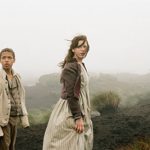
Ostensibly a western, it’s unique in the genre for its obsession with the minutiae of the covered wagon journey: trudging alongside oxen for hours each day; the insistent squeak of the wagon wheels enough to drive one mad; setting up camp; cooking dinner; and in the morning, breaking everything down and repeating again, for weeks on end. Reichardt makes the viewer feel the grueling absence of significant events to break up this monotony, as they slowly make this dirty, desolate, and seemingly never-ending journey toward a horizon that obstinately refuses to get any closer.
The film is based loosely on the true story of a fur trapper, Stephen Meek (Bruce Greenwood), who led a group of settlers on an alternate route — the titular “cutoff” — meant to avoid reported Indian attacks occurring on a section of the main Oregon Trail. The journey ended disastrously for many of the travelers, having followed a man who it turned out didn’t know the harsh desert lands of eastern Oregon as thoroughly as he claimed. However, this historical account isn’t the story Kelly Reichardt and screenwriter Jonathan Raymond tell here. Using the journals of some of the settlers who went through that ordeal as an insight into the psychology of such a trip, they re-imagine the tale as that of a small group of three families, rather than dozens, being led by the headstrong and egotistical Meek.
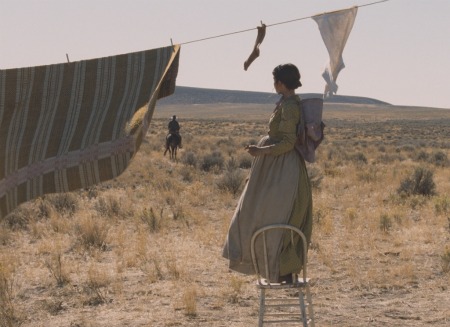 The film begins after things have already begun to turn sour for the settlers, as Thomas Gately (Paul Dano) carves the word “lost” into a fallen log, marking their predicament for anyone else who might pass the same path. As they continue, the situation becomes increasingly dire: Days from their last river crossing, their water stores are beginning to deplete. They dump furniture from their wagons to lighten the load for their thirsty ox teams. And in the distance, they catch glimpses of a lone rider seemingly following them, portending the potential of an Indian attack.
This has all the makings of a hard-scrabble western adventure, and while the stakes are life-and-death, that’s not what Meek’s Cutoff is. Reichardt’s previous two films, Old Joy and Wendy and Lucy, are minimalist character studies, and once again here, she’s more interested in the social norms that dictate the way this journey is conducted and the effect of the growing desperation on the group dynamics.
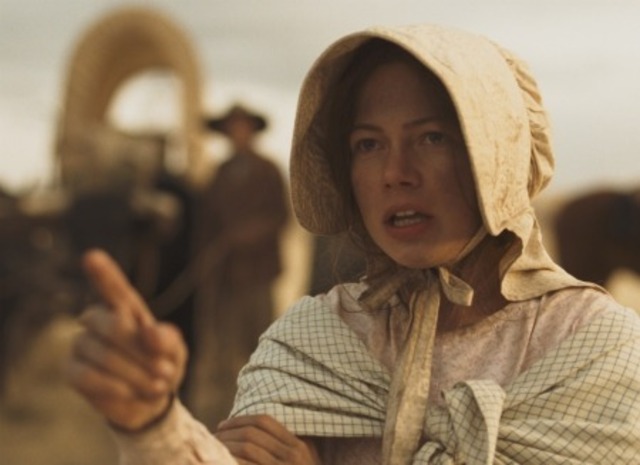
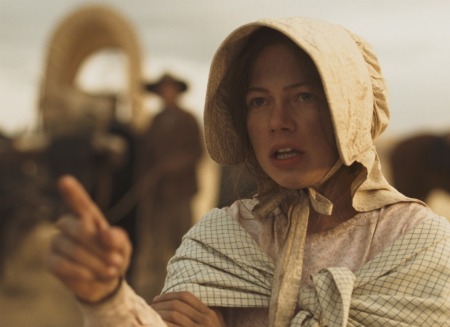
Most importantly, Reichardt lets the film play out from a perspective ignored in the traditional Western: that of the women. Every aspect of the film’s construction is tailored to put the viewer in the heads of the three women in the group. Rather than shooting the expansive vistas in widescreen, the director opts for a constricted, nearly square aspect ratio that cuts out anything in the periphery in favor of what’s happening front and center, reflecting the restricted view offered by the blinder-like bonnets all the women wear. When the men go off to discuss important decisions, Reichardt pushes the audio of their conversations so far down in the mix that it’s barely audible; just as it is for the women watching the conference from a distance.
One of those women, Emily Tetherow — Michelle Williams, delivering a performance of quiet intensity and complexity that may be the best you’re likely to see from any actor in this or many other years — refuses to accept being seen but not heard. She’s long since realized they were lost from the moment they let Meek lead them: “I don’t blame him for not knowing,” she says at one point, “I blame him for saying he did.” Tetherow and Meek’s conflict comes to a head when the men capture the Indian who has been tracking them, and she defies Meek’s assertion that they should kill him rather than risk him taking them out as they sleep. She knows the native may be their only hope of finding their way to water before they wither away completely, and shows him cautious kindness.
Where the Indian is leading them is unclear. He talks a lot, but neither the settlers nor the audience know what it is he’s saying. Again, unlike the traditional western, Reichardt refuses to characterize him as either the villain or the noble savage. He’s just a man who’s fate is now tied to this group, reacting to the situation in which he finds himself just as they are.
The ambiguities and uncertainties mount: is that lone tree in the middle of the desert, seemingly half alive and half dead, a sign of nearby water and their salvation, or the evaporation of their last hopes? When a frustrated Meek says “we’re all just playing our parts now,” it’s a declaration that their fates have already been determined for better or worse. But each of them, with the exception of the defiant, protofeminist Emily, has been playing their socially and religiously assigned parts for the entire movie, and likely their entire lives. The subtle ways in which Reichardt explores those roles is the core of an absolute masterpiece, made with a staggering mastery of the cinematic and storytelling tools at her disposal.
—
Directed by Kelly Reichardt
Written by Jonathan Raymond
Starring Michelle Williams, Bruce Greenwood, Will Patton, Zoe Kazan, Paul Dano
Running time: 104 minutes
Rated PG for some mild violent content, brief language and smoking.
Opens today at E Street.