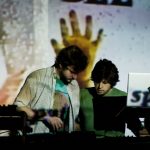
 Interested in the new seven-inch from local electronic duo Protect-U? You aren’t alone. When @futuretiming announces that they’re dropping off that release at a local record store — usually in limited quantities — acquiring them before the day’s end becomes something of a music fan rat race. This doesn’t happen without reason. The sparkling electronic jams of Mike Petillo and Aaron Leitko have a heady otherworldly quality that could just as easily start a chill out night as a dance party. This may be why songs like “U-Uno” have seen some love from sites like Altered Zones.
The two had played together before, but Protect-U is a far cry from the hardcore noise of their band from six years ago, A Day in Black and White. We took the time to talk to Mike and Aaron about the transition from hardcore to electronic music, their adventures in Europe and how they construct their songs.
Find them online: protectuforever.tumblr.com
See them next: Tomorrow night at St. Stephens’ Church with Bluebrain and Painted Face.
Watch their music: Their music video for “U-Uno”
You guys were in a band before, right?
Mike: Yeah. A Day in Black and White. There were a couple of different incarnations, one of which included…
Aaron: …Mike and I. It was a band that our friend Dan from college did that had been through several different members and after their first record, Mike and I got swept into it. But it was fun. We toured. It was post-hardcore-y music, Dischord-y music.
Mike: We got to go to Europe twice. We played a bunch in the States. Did a pretty good record.
Aaron: It was a fairly serious endeavor in 2005 when we toured behind it. Mike was also playing in this band Navies at the time which was his full-time band pursuit.
What did Navies sound like?
Mike: Oh, it was loud, noisy guitar stuff. Sort of what you may expect some people from D.C. around that time to be playing. But also, it was friends of mine. We had been playing together for years through high school so it was cool to do the band and play together. It was cool to meet Aaron, too.
Aaron: Mike and I went to college together.
Mike: But it was cool to do A Day in Black and White together. Then Dan moved to Philly and I was actually living in Philly for awhile and then when I moved back to D.C. from there, Aaron and I started playing what became Protect-U. We had just gotten all this gear.
That’s interesting that you moved from hardcore music to electronic music.
Aaron: Well, it was a gradual thing. Near the end of A Day in Black and White, our friends, like Andrew who runs the label with Mike and Ari had been doing these parties at Black Cat called Reach Up: A Night of Classic Body Music. They were dance nights but even then they had this sensibility that kind of put krautrock style music with new age music and disco music that tended toward really lush soundscape-y things. Ari also had a party in Baltimore when he was living up there called Night Moves. So we had been going up there. Also, on tour with A Day in Black and White, when we went to Europe, Mike had brought with him all this Arthur Russell and this Trax comp and sometimes at night after the show was over, they’d lock us in the venue and we’d blast it on their stereo for the night. So, we had sort of started to get into that music. Then, after that band was over, to start another band like that seemed daunting on a couple of different levels. None of our friends were into that music anymore. Not that it was bad, things had just kind of moved on. Also, there was nowhere to practice. There were complications in even trying to set that situation up again. I think we needed a way in looking at music going forward, we needed a way to try something else, but we didn’t know what that was going to be at the time. I think Andrew had put out the first Max D 7” and those guys were doing Food for Animals still and it was a way to…I had this 707 drum machine and I had bought a sampler and I wanted to try playing music with Mike again so I said, “Why don’t we get together?”
Mike: Tastes, they change, and you start down a slightly different musical path. You say, “I’m going to get into this thing,” and that thing leads you down to another thing and before you know it, you definitely have a slightly different record collection and following different bands and musical ideas and I think we were just at one of those times where we were like, “Let’s jam in a different context.” And it totally made us think about music in a different way. We were so used to working with different things. We’ve both been pretty heavy music heads for awhile and have a bunch of different tastes going into things. I feel like I didn’t always listen to a lot of rock music even when I was playing rock music. It’s funny, I find myself listening to rock music now, maybe more than I did back then. Maybe just not a lot of newer stuff.
Aaron: There wasn’t necessarily an intent to get into it. I just have this gear and we just hooked it up to see what would happen and over the course of basically a year of us just having this stuff set up in Mike’s closet, we would just sort of hit buttons and see what worked and almost on blind luck ran into some sounds that we liked and those sort of pointed the direction of what eventually became what we do now.
So, has the writing process changed at all since you no longer need to find a practice space and can do things at your place?
Mike: Yeah, we still need a physical space to work in. We have a lot of stuff, but we can play it a lot more quietly. I want to say that makes it easier, but I don’t know if that’s the right word because you still spend a lot of time and it takes us a long time to work on stuff. I feel like we jam on ideas a lot in a way that a real band does. You come up with a riff, an idea and you need to play through it a lot of times to come up with the really good combinations. Since we play live, every time we play we try to plan out what we’re going to play and in that moment we’ll start an idea and over the course of the next couple of sets, we’ll play it out a couple of times and be like, “That’s cool,” and then we’ll probably transform it into a song. When we first started we didn’t play live for like, a year. But he can work on some stuff and send me a file and vice versa, but the writing process…we still get entrenched in it.
Aaron: It’s still surprisingly similar to how we used to do things, playing in rock bands.
Mike: In many ways, it’s just that you have so many more options. If you have a synthesizer, you have a hundred different sounds that you can pick from that and you have way more control over the sound so you get kind of caught up in, “What should this one little thing sound like,” when you never used to worry about what a snare drum sounded like in a band. You had a guitar sound…you plug in your guitar to your amp and that’s your sound and then you scream over it. You don’t really have a lot of choices, you just work on the music, so it’s hard to be like, not only do you have to figure out a cool way to do this musical idea but you need to figure out every little sound that we want and what we want it to sound like and it can get a little crazy when we get really obsessive and get in there and it’s like, “We need to change this little tiny thing that no one is ever going to care about,” but I guess any musician probably thinks about that in some way.
I take it there’s not a whole lot of room for improv in the live set?
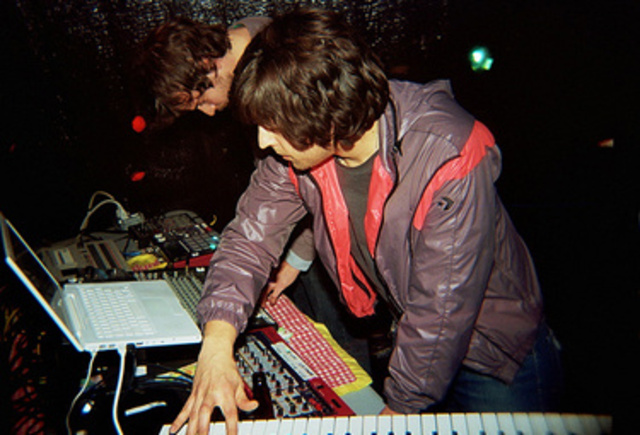
Aaron: I think the way it’s structured in a live sense is that, there are components that are automated but we tell them when to go and when to play back and how to play back and how long. It’s not like we just hit play and the song plays. We have to cue and switch things at the same time and we decide how far to push something before it changes to the next part.
Mike: There’s so much stuff going up there and we only have two hands and we can only do so much, so the songs are naturally going to be shorter or longer in certain parts because we simply can’t get to that change. So, stuff naturally sounds different and mutates every time. So, I think a lot of our songs have to get put through the ringer that way to get to the point where there’s an A, B and a C part that we’ve got to jam out three times live and we know we had it that way in the beginning and when we go to record the track we really have to lock down those decisions.
Aaron: If this makes any sense, if you’re in a band with other musicians, you all work together in causing a change. You change your part and they change their part. But with the way we have our gear set up, it’s like there’s this faucet and it’s on and you’re just changing the way that it flows.
Mike: Yeah, that’s a pretty good description. We set it up, we plan it out, we have to know our set because I have to map it out on my computer so that’s stuff loaded up in a certain way and we just access it at the right time. It’s fun. I think we’re pretty in control of the stuff now.
Aaron: It was not always that way. In the beginning it was harder for us because there were things we didn’t know about the technology. It’s definitely been a learning process to discover how midi equipment works and how to best use and how to develop a way to use that best works in a live performance. In the beginning, the drum machine could start at the same time as the computer but the computer couldn’t tell the drum machine when to change. So, I would have to hit it at the right time but if I didn’t hit it at the right time, it would be off. Or sometimes stuff would come unplugged and the whole set would go down. We’ve gotten a little better at it. We’re working on it.
Sounds like playing live can be pretty difficult.
Mike: It could be pretty risky because there are lots of cables and lots of little gadgets that are supposed to be connected and then it’s a computer and sometimes computers don’t always work the way you want them to so you can’t just bang it out anymore. You can’t just play louder.
Aaron: It’s not like you can just borrow someone else’s guitar. The components of your setup are unique to you and hard to replace. Sometimes there are mysterious problems.
Mike: And now we’re totally relying on a nice sounding PA and if we don’t have that there’s no point for us to play. So we can’t set up in any old bar or any dirtbag punk house.
Aaron: A lot of times we just bring our own sound system which is loaned to us by Justin Moyer of Edie Sedgwick. He’s been really helpful with spotting us with gear and been really supportive. He’ll usually loan us a PA and that’s what makes it possible for us to play house shows which I think we kind of gravitate towards and it’s within our control.
Mike: Hopefully the sound will be good at the church.
Aaron: We were psyched to play a Positive Force show so we figure it’s going to sound how it’s going to sound. We can augment the gear there a little bit with some stuff that we’re borrowing from Justin but I think their PA will be tight. We’ll just try to have a good time.
Speaking of live shows…you guys had a brief trip to Europe this fall. It definitely sounded like an adventure.
Mike: Many things happened at once that sort of brought us there. This Belgian label wrote us and we ended up doing a remix for them for an artist that they’re putting out and in talking with Michael from the label, we struck up a conversation about coming over there to play some time. Then, basically, Beautiful Swimmers got an offer to play in Amsterdam and they wanted another show or party to play over there to make it financially worthwhile and they couldn’t find anything so I was like, “Maybe you guys could play Belgium. Belgium’s close to the Netherlands, right?” So, I was talking to Aaron and asked, “Do you want to go over and play this show, too, randomly, in this small town in Belgium” and he was like, “F**k it. Yeah.” So, I was going to take a trip anyway. It was my thirtieth birthday so I was going to Europe and going to Spain and gonna hang out and everything so it kind of just became a trip for me and I was like, “Do you want to come?” So we played and it was crazy because snow hit that morning and f***ed up all the trains and we almost didn’t get there which would’ve been really crazy but we did and it was pretty fun.
Aaron: It was a lot of fun. It was a four day trip to Europe though, so at the back of my mind, I was kind of like, “I have to go to work on Tuesday…on the other side of the Atlantic Ocean.” And it snowed so it was difficult for us to get from Amsterdam to Belgium so we were stuck in the train station in Utrecht for four hours or something. The promoter was a real hero. He sent a friend of his in a car to come pick us up and that’s sort of like driving from here to Philly to get us in through the snow storm. He showed up in this little hatchback and we all piled in there and we barreled down the highway at 1000 km/hr or something to get to this show through the snowstorm. I remember thinking that this was a little bit like The Day The Music Died for Future Times. If this car goes off the road, that’s the end. But it turned out okay! It was tight. We had a really good time. The promoter, Michael, was really great and the deal in Amsterdam for the Swimmers show. They gave us a hotel to stay in. It was a little stressful but I had a really good time.
Mike: We were also traveling on the equivalent of the Dutch Christmas Eve so the trains were packed and it was just a f***ing nightmare but it was super fun.
What were the crowds like over there?
Mike: It was fun. The Amsterdam party…we didn’t play but it was really good response to the DJing and European dance music is very different. It’s much more accepted that people are going to go and hang out all night at a club. It’s more prevalent and they have a little bit more of an open mind with that sort of electronic stuff. They’re really eager to check out new sounds and stuff that they haven’t heard before. So, I think they were pretty into our music and seemed to have a really good response. It was a really small town over there so the most frequent question we got was, “What are you doing here?” We were like, “What? It’s cool!” They were like, “This is so random.” And I was like, “I guess it is.” We were driving around and there were cow farms. It was in the country of the German-speaking part of Belgium near Germany and near the Netherlands.
Aaron: We’ll hopefully try to go back in the fall. We’re trying to plan that out right now.
Mike: We’re trying to figure out our gear situation but we did it once, we can do it again. It was not the best situation for us because we got there without having time to soundcheck or anything so we just kind of loaded in which was a little bit of a problem but I’m amazed that it worked at all.
Aaron: They promised us a power converter which worked but it looked like…
Mike: Like something that Doc Brown had taken out…or like something I’d ordered from the back of a comic book.
Aaron: It looked the a flux capacitor. I looked at it and Mike said, “Don’t plug anything expensive into that, yet.” It did work. It was a little bit steam punk but it did the trick. We’ve been out to San Francisco to play some shows, too, so we’re getting around. We’re doing okay.
Mike: We’ll keep doing it until we break all of our shit and then we’ll probably have to stop.
Some of your shit has broken?
Mike: It’s just gotten weird. We’ll bring a drum machine back from a trip and certain drums won’t want to play anymore.
Aaron: Things are just a little more mysterious than they used to be.
Mike: For the most part everything’s fine, but we need to probably invest in some nice road cases.
Mike, when did you and Andrew start Future Times?
Mike: About 2008?
What was the impetus behind that?
Mike: My old band had put out some self-released things and I’d always been interested in that aspect of doing some legit label. When I moved back to D.C. from Philly and Andrew and I were hanging out all the time and he put out his own thing and I thought it was really good and we were literally like, “Let’s do something else. Let’s start doing something,” and it’s been good. It’s been a good way of getting our music out and it’s been a good response and people seem to be into and we’ve kind of developed a little bit of an aesthetic, I guess, musically, which is cool and we’re just all working on music all the time so, if nothing else between our two projects we know we have a label. But along the way, we’ve put out some other folks’ stuff, too, so, we’re going to continue to do that and it’s a fun thing to do. We don’t really get stressed out by it which is awesome. It’s not business really, yet. I mean, it is but we pretty much do it when we have spare time.
Aaron, how many bands are you in right now?
Aaron: Just this and S PRCSS.
Mike: I have to ask myself the same question sometimes for him.
Aaron: A year ago I had a lot of time. I was still a freelancer so I had a lot of time to go to practices. So, near the end of that I had joined all these different bands, I was like, “I’ll play with everybody!” but then I got my job and I wanted to devote most of my time to doing this. I got a job and we just had a lot more opportunities with this and it demanded more time and I was more interested in spending time on that. S PRCSS is a fun band to be in but it’s kind of like Bob’s band. Bob and Justin’s band. I play bass and book for it but I can do that from a little more of a removed position than this. But, ya know, session man available for bass guitar gigs!
You’ve already told the City Paper that you got the name for one of your songs, “Double Rainbow” from the Kim Jong-Il origin story. Do you regularly go to such heady sources for your inspiration?
Aaron: No, that song was just really bright as opposed to some of the noise and harshness in D.C. music culture. So, we had this song with all these bells and twinkly synths so I was like, “Let’s call it Double Rainbow.” I thought it was a funny title and it was bright and cheery and plush in contrast to dudes breaking guitars and howling through a wizard bong that was plugged in through four Sun Cabs. That stuff was definitely cool.
Mike: In my mind it fit the sound and in instrumental electronic music, what are you going to call the songs? Files are saved “FunkyJam01” and “HouseJamNumber2.”
Aaron: With most of the titles, there’s not a lot of thought that goes into them. They don’t have a ton of philosophical baggage or anything. Especially not “Double Rainbow.”
Mike: I had no idea that dude was on David Letterman. That’s so hilarious.
Aaron: It bums me out now that you tell people about it and they’re like, “Like the Double Rainbow thing!”
Mike: We’re not trying to get that heady.