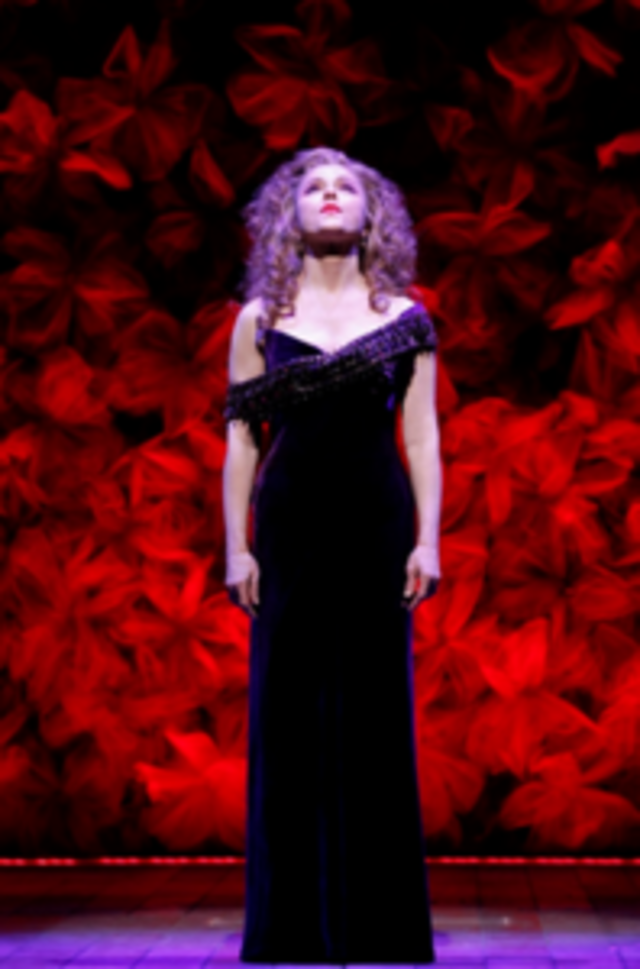
 Bernadette Peters in “Follies”.
It may feature some of the greatest musical theater songs from one of its most celebrated composers, but for audiences, Stephen Sondheim’s Follies has always been kind of a hard sell. Is it the depressing storyline, with its ruminations on mortality and fidelity? Its pastiche-heavy multi-song fantasy sequence? Do folks not want to invest almost three hours of their time to watch a musical about aging, fading stars?
Director Eric Schaeffer tries to get audiences to give the show another shot with his Kennedy Center revival of Follies, an ambitious production with jaw-dropping costumes and some major starpower from such theatrical legends as Bernadette Peters and Elaine Paige.
And the pulse quickens as each of these legends marches onstage during the show’s opening sequence, when the former stars of the (fictional) Weissman Follies gather decades later for a reunion, as their old theater is about to be demolished in favor of a parking lot. There, they ruminate about loves lost and years wasted.
Schaeffer’s production uniquely captures the melancholy spirit of Follies. The theater is “haunted” with slow-moving, black and grey-decked showgirls, who glide eerily through the proceedings, a reminder of the theater’s past. They provide sharp contrast with the lush, feather-decked set of the show’s “Loveland” sequence, an abrupt turn in the second act where each main character’s central conflict, or “folly,” is acted out in song and dance.
Peters is the more recognizable of the show’s two female leads. Physically, she’s an unusual choice for the part (it’s hard to imagine her Sally fretting over her looks and figure when Peters looks like she hasn’t aged in years). But she makes up for physicality with a raw, vulnerable take on the character, pouring her heart out in the show’s obsessive ballad, “Losing My Mind”. She’s nearly upstaged, however, by her costar Jan Maxwell as Phyllis, who has played the dutiful wife for years to Ben (Ron Raines), a politician with a wondering eye whom Sally has lusted after for decades. Maxwell’s defiant rendition of “Could I Leave You?” is Follies‘ most cathartic moment, and she dials up the sex appeal with the amusing, yet poignant “The Story of Lucy and Jessie”, the most satisfying of the show’s big-production numbers.
The show’s cameo performances are more of a mix. Paige has a husky, sultry presence as Carlotta, the dame who’s seen it all, but her rendition of “I’m Still Here”, one of the most oft-performed Broadway songs out there, is a little bizarre: first offhand and casual, and ultimately overdramatic. (It’s still a joy to hear her distinctive, lilting voice, though.) Linda Lavin has the audience eating out of her hand with the crowd-pleasing “Broadway Baby”, but French singer Régine is out of place (and really, out of her league), giving an awkward, slurred rendition of “Ah Paris!” Oh yeah, and there are a few men in the show, too — of the leads, Danny Burstein is the more sympathetic as the emasculated Buddy; Raines’ voice is powerful, but his delivery often wooden.
The casting may not be pitch perfect, but Schaeffer’s Follies succeeds because it wreaks havoc on the emotions — as we watch beloved characters spiral downward, it’s hard not to be awash in feelings of our own regrets and missed opportunities. It’s not just an old theater that gets haunted here.
Follies runs through June 19 at Kennedy Center. Tickets are available online.