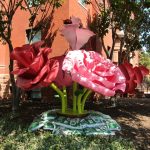
 Frank Stella, K.54, 2008. Protogen RPT with stainless steel tubing, 80 x 53 x 37 in. FS2008.048. Calvin and Jane Lipton Cafritz. © 2011 Frank Stella / Artists Rights Society (ARS), New York. Photograph © 2011 Bruce White.
Sound and silence interact in The Phillips Collection’s installation of works by two modern masters who are separated by time and place, but whose works resonate with each other.
The Philips Collection continues its anniversary celebration 90 Years of New with complementary exhibits of works by Russian master Wassily Kandinsky and American artist Frank Stella.
Stella Sounds: The Scarlatti K Series is a body of recent sculptural work that is a logical and literal extension of the striped abstractions — inspired by Barnett Newman’s zips and Jasper Johns’ targets — that first brought Frank Stella to fame. Kandinsky died in 1944, but this recent work from Stella demonstrates the Russian’s influence on contemporary art. The interaction between these two artists is more specific: Stella has written frequently about Kandinsky and in fact contributes cell phone tour audio for works in the Kandinsky galleries. The Scarlatti K sculptures, which the artist began working on in 2006, intrude into the gallery space — watch that you don’t snag your tote bag on the inviting armatures. Inspired by the music of Italian Baroque composer Domenico Scarlatti, the curved lines, as well as the varied hues present in painted sculptures like K.43 (lattice variation) protogen RPT (full-size) (2008) evoke music, as well as a kind of abstract rollercoaster. The sprawl of K.43 and other dynamic pieces are served well by the Phillips’ beautifully lit third-floor galleries. Most of their time will be spent bathed in the glow from a skylight, but the inevitable summer storms that will pass overhead should give them an aura of delicate sea monsters, trapped in their own netting.
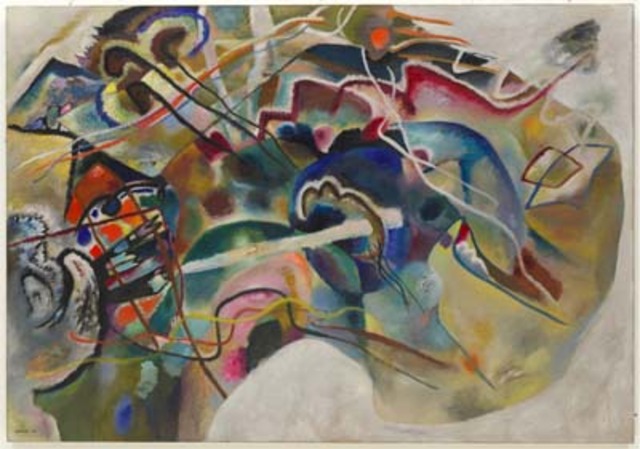
The genesis of Kandinsky and the Harmony of Silence: Painting with White Border came from one of the Philips Collections treasures, Sketch 1 for Painting with White Border (Moscow) (1913). The dark, clasutrophobic canvas appears to be a finished painting, but it is simply a crucial step towards a more expansive final product. Many of Kandinsky’s studies for Painting with White Border (1913) are reunited here, so the exhibit is very much a document of the artistic process — you see ideas worked out in pencil, ink, crayon, watercolor and finally, oil.
 Wassily Kandinsky, Painting with White Border (Moscow), 1913. Oil on canvas, 55 1/4 x 78 7/8 in. Solomon R. Guggenheim Museum, New York, Solomon R. Guggenheim Founding Collection, By gift 37.245. © 2011 Artists Rights Society (ARS), New York / ADAGP, Paris.
The central work in this exhibit comes at a time in 1913 when Kandinsky had moved away from representation, but had not yet completely immersed himself in abstraction. The artist became increasingly enchanted with how objects would lose focus and “dissolve” in twilight, and this shapes — and unshapes — his treatment of certain key motifs. Representational works from just a few years before depicted immediately recognizable figures of the troika (a carriage drawn by three horses) and Saint George, an icon of the Russian Orthodox Church who, as legend has it, slew a dragon. A close look at Painting with White Border reveals abstractions of both motifs. Saint George can even seen with his lance, attacking a creature that looks to me like a horned Yeti.
The border motif marked a further jumping off point for Kandinsky. While the demarcation in White Border is loosely defined, it becomes more distinct in later works on display at the Phillips, including Painting on Light Ground (1916), which resembles an page of an abstract book against the titular background, and Red Oval (1920), whose jade border evokes oxidized bronze. Border also recalls the central motif of Rooms with a View: The Open Window in the 19th Century, the Metropolitain Museum of Art’s survey of European paintings that feature windows in the composition. This Romantic device is used either to frame a landscape within a larger frame, or to study the effect of natural light cast inside a room — the latter of which may be a clue to the “dissolving” objects within Kandinsky’s borders, which frame Saints and horse-drawn carriages in a hazy light.
If Stella’s sculptures across the hall recall lyrical sea monsters, Kandinsky also looks to the watery part of the world for inspiration with his Improvisation 31 (Sea Battle) (1913), one of the works on view in a brief survey of Kandinsky’s later work. Related pieces from the Phillips Collection are also on view in a gallery of the artist’s contemporaries, which includes simpatico work from Paul Klee, and a welcome display of collages from Kurt Schwitters. Kandinsky’s 1935 canvas Succession makes explicit the musical themes hinted at in White Border, as it looks very much like whimsical notes on a scale.
Kandinksy and the Harmony of Silence coincides with the centennial of the artist’s influential treatise, Concerning Spirituality in Art, dated 1912 but released in time for Christmas season of 1911 (an artist has to know his market, after all). In this work, Kandinsky contrasted black and white, calling the former a “dead silence” and the latter a “harmony of silence … pregnant with possibilities.” The white walls of The Phillips Collection’s galleries are an perfect space for such contemplation.
Kandinsky and the Harmony of Silence: Painting with White Border and Stella Sounds: The Scarlatti K Series are on view at The Phillips Collection from June 11-September 4, 2011. On Saturday, June 11, from 10 a.m. – 5 p.m., join leading artists, conservators and scholars for the symposium, Kandinsky: Looking Forward, Looking Back, included in admission to special exhibition; free for members.