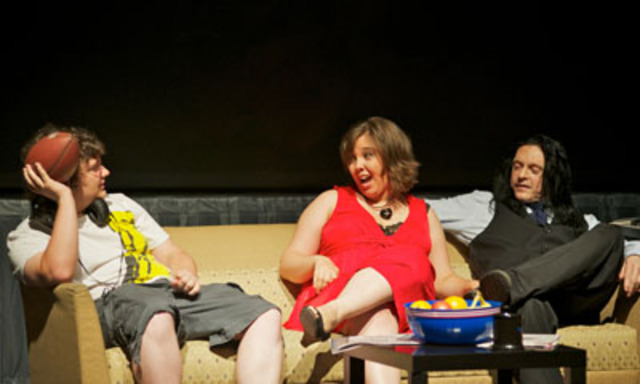
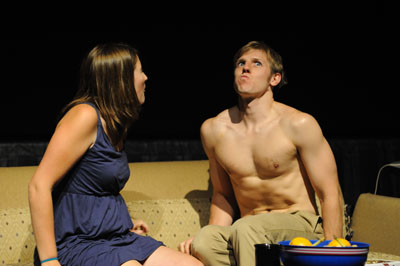
 Denny (Eric Koenig), Lisa (Taylor Barnes), and Tommy Wiseau in The Room Live. Photo by Pat Padua.
Friday night, D.C. saw the first ever live staged reading (not counting a Brooklyn theater company’s adaptation) of Tommy Wiseau’s cult hit The Room. I’ve seen the movie five times, including two theater screenings, but the audience participation, funny as it (sometimes) can be, isn’t what keeps me coming back. For all Tommy’s faults as a director, writer and actor, he’s a singular character — thoroughly unself-conscious, earnest, naive and, in his personal appearances, unflappable. If it’s all an elaborate piece of performance art, as some have suspected, it may be the most brilliant performance art piece of our time. But I think he’s simply being himself, despite the slings and arrows of outrageous ridicule that are nevertheless making him a fortune.
[Note: this review contains numerous spoilers for those who have never seen the movie, and also reveals some of the surprising ways in which the play departs from the film. But as one actor told the audience in a Q&A after the performance, the next show you see will likely be completely different.]
This live performance also starred Greg Sestero, who played Johnny’s best friend Mark in the film, and a cast of local actors. A preview of rehearsals, posted by the AFI Friday afternoon, gave me some pause. The last thing I wanted to see was a cast that camped up the proceedings, and the preview made me worry it would go just that way.
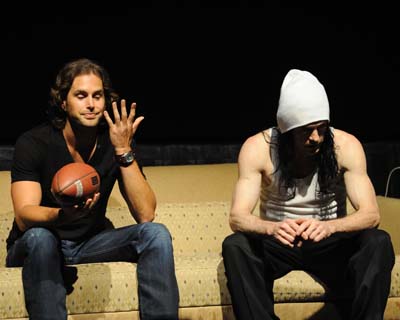 Greg Sestero and Tommy Wiseau.
It was by no means a polished production — it was barely a production. An announcer told the audience that there had been no run-through. “God have mercy on your souls,” he warned us, as if the feared train-wreck would come to pass. And a kid who sat next to me who came to the play never having seen The Room uttered his wrecked assessment out loud. But except for one major exception, The Room Live lived up to the spirit of its beloved source.
The exception? Sestero, who was knowing, smug and clearly didn’t want to be there. What actor would want to be associated with The Room? One with a sense of humor about himself, like Juliette Danielle and Philip Haldiman — the original Lisa and Denny, respectively — who have embraced the spectacle that Tommy has wrought. Danielle is a particularly good sport about it, as the audience participation jokes are frequently made at her expense. Sestero, who is planning to write a tell-all book about the making of the movie, does not appear to share his colleagues’ self-effacement even though his hipper-than-thou departures from the film were appreciated by much of the audience. The play promised to explain and add depth to our experience of The Room, but many of the additions are just self-reflexive and knowing — traits that are refreshingly lacking in the movie.
 Michelle and the Me Underwears guy
Take, for instance, the movie’s cafe scene. Audiences who see The Room wonder out loud why nobody pays for their drinks. As this scene plays out on stage, Tommy leaves Mark behind and a waitress comes to give him the bill. Sestero smirkily counters, “but I thought everything was free.” When the script works in such remarks — the kind that audiences are used to shouting out at screenings — the internal logic (or illogic) that makes the original such an unusual experience falls apart. Such self-consciousness is not what The Room is about at all. It’s as if you remade Last Year at Marienbad and provided a back story. Marienbad exists in its own world with its own logic, and you become lost in it. So it is with The Room, whose inexplicable use of green-screen for the film’s roof-top scenes adds a surreal element to, “Oh hai, Mark!”
Still, departures from the script were sometimes simply due to lack of rehearsal. Tommy embraced this. In a scene where Michelle and Lisa are discussing “girl talk,” the actress playing Michelle, Katie Buenneke, reads from a script; when Tommy entered the scene, he pulled the script out of the actress’s hand and threw it into a grateful audience.
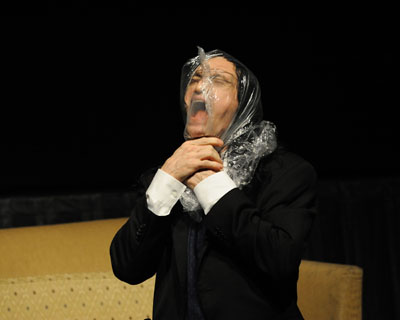 “Gahd forgeeve me!” Photo by Pat Padua.
The actors who play Lisa (Taylor Barnes) and Denny (Eric Koenig) acquit themselves well, and did not make you long for Danielle and Haldiman. Eric Koenig, who played Denny, one of the film’s most beloved characters, had particularly big shoes to fill and accomplished this by being a completely different kind of Denny — he pulls off the neat trick of playing a goofy kid without being self-conscious about it. Another casting coup features the character more widely known as “Me Underwears” guy, played by William Hayes Cromartie. The most obnoxious character in the film, Cromartie takes his role seriously, which is precisely what makes it funny.
It was easily the most anarchic evening of live theater I’ve ever seen. During intermission, audience members pounced on stage to pose for pictures with a framed spoon photo (a recurring motif in the movie) that dotted the set. Hipsters smiled next to the spoon and gave the thumbs up for their portraitist. During the climactic birthday party scene, audience members descended upon the stage to play party guests. When Tommy announces “we’re expecting!”, one of these impromptu extras (who had interviewed people in line before the show) approached Tommy with arms outstretched for a congratulatory hug. Tommy didn’t skip a beat, reciprocating with a hug and beginning a theatrical receiving line of handshakes that, like vintage Jerry Lewis, kept the scene going for much longer than was comfortable.
Technical problems diminished the experience somewhat: lighting was uneven and no microphones were used, so a lot of dialogue was lost in an auditorium that wasn’t made for live theater. This is a problem I’ve had with audience screenings as well, where a cacophony of shouts inevitably drowns out some of the movie’s most hilarious lines. Tommy himself flubbed a few: “I’m tired, I’m wasted, I love you darling!” was mostly addressed with his back to the audience, a la Miles Davis. But one person’s train wreck is another person’s inspirational simulacra of the messiness and unpredictability of life.
The most inspired departure from the film is Tommy’s suicide. His last line in the movie is, “God forgive me,” after which he shoots himself in the head. But when he uttered the line onstage, there was no prop gun in sight. Instead, he slowly raised a plastic bag to his head and pretended to suffocate himself, finally falling onto the floor with the bag over his face. It may seem cruel to laugh at a man pretending to kill himself, but somehow holding a bag over his head is a touchingly funny translation of cinema to stagecraft. The Room Live is not Good Theater, but it was winningly chaotic night of Great Bad Theater.